|
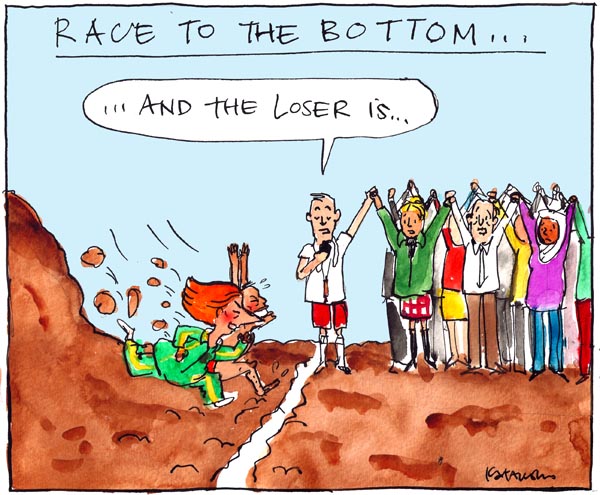
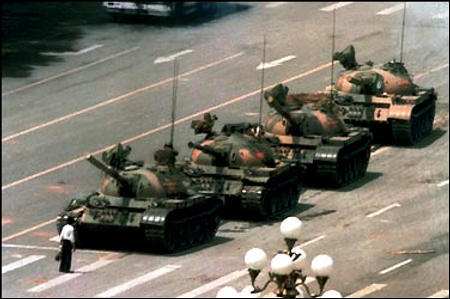
| Can revolutionaries bring change without imitating the oppression forced upon them? http://goo.gl/2Bj5k |
Marx’s theory of historical materialism
rests on an indefensible economic reductionism. Critically evaluate.
In The
Communist Manifesto, Marx argues that ‘the charges against communism made
from a religious, a philosophical and, generally, from an ideological
standpoint, are not deserving of serious examination’ (Marx,
Engels, & Moore, 1998, p. 18). In this essay
I will argue that many of these criticisms of Marxist style political and
economic communism are deserving of serious examination. First, the
terms ‘materialism’ and ‘economic reductionism will be examined’. Second, a
brief overview of Marx’s thoughts in regard to the question will take place.
The problems surrounding economic reductionism, materialism, and the inevitable
violent outcomes of these theories will then be discussed.
According to the
Routledge encyclopaedia of philosophy, materialism is ‘a set of related
theories which hold that all entities and processes are composed of – or are
reducible to – matter, material forces or physical processes.’ Furthermore, ‘Materialism
entails the denial of the reality of spiritual beings, consciousness and mental
or psychic states or processes, as ontologically distinct from, or independent
of, material changes or processes’ (Wood,
1998).
Materialism provides an exact scientific basis to life. For Marx, materialism
is able to explain descriptive phenomena, providing a basis of history. From
this basis of history, through its epochs and revolutions, patterns emerge. These
patterns, from a materialist setting, emerge due to the economic relations of
society. Marx’s theory is better understood as deterministic or fatalist rather
than prescriptive or moral (Croce,
1966, p. xi). According to Marx, the economic
sphere is ‘the real foundation of society’ and therefore, ‘labour is the
essence of humanity’ (Hughes,
2007, p. 67; Marx & Engels, 1968, p. 182). The suggestion
that economic science is the basis of society leads to economic reductionism,
which is the natural outcome of materialism.
Economic
reductionism, which stands at the centre of Marx’s thought, is laced with
problems. Marx perceives a broad range of issues in society which through
scientific historical analysis he explains the economic epochs which human societies
have weaved through. He expresses strong concern in regard to the oppression of
the proletariat (the working class) throughout his work, while voicing an equal
degree of contempt for the middle-class bourgeoisie. As Dupré aptly summarises
in The Philosophical Foundations of Marxism, Marx’s chief concern is
that ‘those who contribute most to the production receive the least enjoyment
from the actual product’ (Dupré,
1966, p. 149). Marx expresses further contempt
for the bourgeoisie in The Communist Manifesto by stating that they have
‘agglomerated population, centralised means of production, and has [sic] concentrated
property in a few hands’ (Marx
et al., 1998, p. 7). He also expresses concern for
child labour on multiple occasions (Marx
et al., 1998, pp. 17, 20). Marx is not
specifically concerned with the immorality or metaphysics of oppression, but
rather, his concern regarding oppression is in relation to the progression of
history. While referring to the phenomena as a struggle between proletarians
and bourgeoisies, he also implies that the transition to communism is part of
the unfolding development of human history. It seems that while with one hand
Marx denies morality as a facade for religion through showing its
incompatibility with materialism, with the other hand, he employs morality into
his discourse with moral prescriptions and ethical assessments.
In The Communist Manifesto, Marx
writes that ‘the theoretical conclusions of the Communists are in no way based
on ideas or principles that have been invented, or discovered, by this or that
would-be universal reformer. They merely express, in general terms, actual
relations springing from an existing class struggle, from a historical movement
going on under our very eyes’ (Marx
et al., 1998, pp. 13–14). He uses a
bottom-up materialist approach rather than a top-down spiritual understanding
of the world (Dupré,
1966, p. 155). This has strong implications for
any theorist, philosopher, or theologian who may suggest that meaning can be
derived from outside the economic sphere. As one writer suggests, ‘any
interpretation that sought to detect aesthetic and ethical elements of Marx’s
thought must address his critique of ideology and his apparent reductionism in
viewing the ‘superstructure’ as simply determined by the economic-material
base’ (Hughes,
2007, p. 64). Marx’s reductionism denies the
moral and philosophical realm, retendering it ‘not deserving of serious
examination’, which begs the question, ‘what is one to do according to Marxist
law?’ Should one stand aside from the unfolding of history, or perhaps, try to
speed its progress?
It is clear that Marx suggests that
there is some kind of moral imperative in his theory. Marx concludes The
Communist Manifesto by stating, ‘the proletarians have nothing to lose but
their chains. They have a world to win. Workingmen of all countries, unite!’ (Marx
et al., 1998, p. 30). His conclusion draws out two
problems, the first is conceptual while the second is practical. The conceptual problem is that Marx gets an
‘ought’ from an ‘is’, and moreover, from an ‘is’ that is entirely based on a
materialist conception of history. It is difficult to predict the trajectory of
history, and even more problematic to understand morality in terms of economics
and history alone. Hypothetically, if the next stage of history was the further
oppression of the working people, the exploitation of the environment, and the
extinction of various animal species; it would be difficult to tell what Marx’s
moral prescriptions would be. It seems to be of pure coincidence that Marx’s
next stage of history, when the proletarians violently overthrow the
bourgeoisie, happens to synthesise with some conceptions of morality. As for
the practical refutation of encouraging ‘workingmen of all countries’ to
‘unite’, it is interesting to note that there is no longer a clear division
between the proletarians and the bourgeoisie, meaning that no longer are proletarians
across the world united in struggle (Milanovic,
2011, pp. 110–111). Revolution seems less likely as
the proletarians become more comfortable. Poverty was once driven by class, but
it is now ‘almost entirely driven by location’ according to Milanovic (2011,
pp. 112–113). Poverty in developing countries
calls for a revolution of kinds, yet Marx seems to make no prescriptions here. It
is ironic that workers in country A who are wealthier than the bourgeoisie in
country B, must be equally concerned with political change in their own midst
as they should be with the lot of the workers in country B who are much
worse-off than they are. According to strict Marxist thought, modern
understandings of poverty and development are irrelevant. The famine stricken
Somali villagers must form unions and violently overthrow the classes who hold
them back. If ‘man’s essence depends on his productive activity, and this
activity is determined by nature’, then it seems that we will be led to these
illogical conclusions (Dupré,
1966, p. 148).
It is interesting that Marx seems
to support the intrinsic value of the human being. He wants to abolish the
‘miserable character of this appropriation, under which the labourer lives
merely to increase capital’ (Marx
et al., 1998, p. 15). Marx also voices his opinion
against children being ‘transformed into simple articles of commerce and instruments
of labour’ (my
emphasis, Marx et al., 1998, p. 17). While I side
with Marx’s concern, it is philosophically problematic for Marx to accept the
concept of intrinsic value while simultaneously being a firm supporter of
historical materialism and economic reductionism. It is understandable that
Marx attempts to integrate a Kantian understanding that it is inappropriate to
use another person as a ‘mere means’ to generate ecumenical appeal, however, to
argue that children should not be ‘transformed into simple articles of commerce
and instruments of labour’ presupposes that there is another basis to the value
of humans that is neither economic nor material. If there was child labour
intended to help the working class, it would seem that Marx could not take
issue with it.
In the final section of this paper, the issue
of Marx’s prescriptions, especially those in relation to violence, will be
discussed. Marx suggests in The Communist Manifesto that ‘the violent
overthrow of the bourgeoisie lays the foundation for the sway of the
proletariat’, and later that the Communists ‘openly declare that their ends can
be attained only by the forcible overthrow of all existing social conditions’ (Marx
et al., 1998, pp. 12, 30). He also
suggests that the ‘overthrow of the bourgeois supremacy’ and the ‘ conquest of
political power by the proletariat’ is part of the ‘immediate aim’ of (Marx’s
version) of communism (Marx
et al., 1998, p. 13). Croce articulately discerns that
an action ‘may have economic value without being moral, and the consideration
of economic value must therefore be independent of ethics’ (Croce,
1966, p. xvi). Therefore, the ultimate problem
of Marx’s theory is that it cannot care whether an action is moral, but only
whether an action has economic value. Leo Tolstoy argues that the means of
socialist revolution are ‘in the first place and above all, immoral, containing
falsehood, deception, violence, murder; in the second place, these means can in
no case attain their end’ (Tolstoy & Stephens, 1990, p. 62). Tolstoy gives
a two part criticism to socialist revolutionary theories of change. The first
part pertains to the means being ‘immoral’. This will be considered as the
philosophical distinction. The second part of Tolstoy’s criticism relates to
the means being unable to achieve their desired ends. This will be considered
as the pragmatic distinction. Both Tolstoy’s philosophical and pragmatic
distinctions are powerful criticisms of Marx’s prescriptive thought.
Tolstoy shares Marx’s concern for
the working class and the oppressed. He writes that the ‘men of the ruling
classes, who have no reasonable explanation of their privileges, and who in
order to retain them are forced to repress all their nobler and more humane
tendencies, try to persuade themselves of the necessity of their superior
position; while the lower classes, stultified and oppressed by labour, are kept
by the higher classes in a state of constant subjection’ (Tolstoy, 2009, p. 284). Tolstoy hears
the cries of the oppressed, and while he is committed to pacifism, he is not
committed to being passive. He suggests that the people should cease to support
the army, a body of working class people who have been convinced to repress their
working class peers in the interests of the wealthy (Tolstoy
& Stephens, 1990, pp. 61–63). Tolstoy argues
that if power, or the current structures of its manifestations, are to be
abolished it must be abolished not by force but by man’s awareness of its lack
of utility and intrinsic evil. When men refuse to join the army and refuse to
pay taxes the foundations of the current order will crumble. Tolstoy’s
conception of nonviolent social change rests on the premise that there is some
degree of humanity to be found in the so-called evil oppressors. He suggests
that ‘our wealthy classes, whether their consciences be tender or hardened,
cannot enjoy the advantages they have wrung from the poor, as did the ancients,
who were convinced of the justice of their position. All the pleasures of life
are poisoned either by remorse or fear’ (Tolstoy,
2009, p. 108). Therefore, it would be better for
one to suffer than to oppress, as living a moral life, according to Tolstoy, is
of far more value than imitating one’s oppressor. Tolstoy’s thoughts paved the
way for the struggle for independence in India as a practical alternative to
civil war. Gandhi described himself as ‘Tolstoy’s devoted follower’ and said
that Tolstoy’s writings ‘overwhelmed’ him (Lavrin,
1960, pp. 132–134). As Tolstoy suggested, and as
Gandhi proved, non-violent revolutions are possible and they also have greater
chances of success than violent revolutions, which contradicts Marx’s thoughts.
Peace and Conflict researcher Stephen Zunes suggests that ‘less destructive
means can be found to overcome dictatorial regimes and unjust social systems’.
He cites Iran, Bolivia, Sudan, Haiti, Philippines, Mali, and Madagascar as
nations who have been able to overthrow oppressive states through non-violent
action. Non-violent action in South Korea, Chile, Mongolia, Nepal, Bangladesh,
and Kenya has also led to some reforms (Zunes,
1994, p. 405). While Marx would cast away the
idea of a non-violent proletariat revolution as an idea that is merely religion
in disguise, the tangible evidence of non-violent revolutions not only being
moral but being more effective in achieving their ends is problematic for
Marx’s narrow path to freedom.
Marx’s historical materialism and economic
reductionism inevitably leads to the imperative for the proletariat to
violently revolt against the powers that be. The narrow reductionism and
materialism purported by Marx presupposes that the essence of man is his
productive capacity, ignoring any other realm of influence. While his concern
about the poor, property ownership, and the idle bourgeois is justified, his
solutions are dangerous, immoral, and ineffective at achieving their ends.
Bibliography
Croce, B. (1966). Historical materialism and the
economics of Karl Marx. London: Cass.
Dupré, L. K. (1966). The
philosophical foundations of Marxism. New York: Harcourt, Brace &
World.
Hughes, J. (2007). The
end of work : theological critiques of capitalism. Malden, MA: Blackwell
Publishing.
Lavrin, J. (1960).
Tolstoy and Gandhi. Russian Review, 19(2), 132–139.
doi:10.2307/126735
Marx, K., & Engels,
F. (1968). Selected works : in one volume. London: Lawrence and Wishart.
Marx, K., Engels, F.,
& Moore, S. (1998). The Communist manifesto. London: Merlin Press.
Milanovic, B. (2011). The
haves and the have-nots : a brief and idiosyncratic history of global
inequality. New York: Basic Books.
Tolstoy, L. (2009). The
Kingdom Of God Is Within You. Guildford: White Crow Books.
Tolstoy, L., &
Stephens, D. (1990). Government is violence : essays on anarchism and
pacifism. London: Phoenix Press.
Wood, A. W. (1998).
Dialectical Materialism. Routledge Encyclopedia of Philosophy.
Routledge. Retrieved from http://www.rep.routledge.com/article/N013
Zunes, S. (1994).
Unarmed Insurrections against Authoritarian Governments in the Third World: A
New Kind of Revolution. Third World Quarterly, 15(3), 403–426.