Showing posts with label democracy. Show all posts

Wednesday, October 24, 2012

BAE Systems: Censoring the voices of the people

The site of the latest BAE Systems protest - with many more to come


Why is it that a company like BAE Systems would not want a couple of Gandhi & Martin Luther King, Jr. quotes pasted around their Facebook page?

Why is it that a company like BAE Systems would censor any views which they disagree with, no matter how politely they are put? 

Why is it that a company like BAE Systems who claims to be fighting the 'war on terror' would, in the most undemocratic fashion, silence the voices of the people?

Maybe it's because BAE Systems are one of the largest, if not the largest arms producer in the world. They sell weapons to over 100 countries including Israel. They are a threat to national security. They are a threat to human security. They are a waste of, what essentially is tax payer's money.

You don't need to do much research to find out about the instances of bribery and corruption within their ranks. BAE Systems have been caught breaching arms control regulations which aim to prevent weapons falling into the wrong hands.

Don't let BAE Systems fool you. They are not a civilian transport organisation. They are primarily involved in the arms trade. 

They're not on a particular side of global conflicts. They are on every side of global conflicts. 

They are in it for the money. If the wars stop, their profits go down. It's in their interest for people to keep blowing each other up.

I plan on posting more about BAE Systems. Fortunately here they cannot censor what I say, although I'm sure they will try. I hope to have a video from a recent protest outside their offices in Melbourne posted shortly.

Maybe it is time for us to stand up against this organisation. Post your city below - there is probably a BAE Systems office near you. Organise a protest, a blockade, a letter handout. Do something. Change the world.

Monday, August 13, 2012

Peter Singer on Q&A tonight

Tonight's Q&A Panellists


Thought I would blog a quick post mentioning that Peter Singer will be on ABC's Q&A tonight. If you live in Australia, you will be able to catch up on ABC iView if you miss it.

As you are probably aware, I have written a few too many essays about Peter Singer's views on various ethical issues. These essays have included my comparison of Singer and Rawls on International Justice. In this essay I was cautiously supportive of Singer's views on most international relations issues like increased foreign aid. However, I was sceptical about his ideas on refugee issues - and I'm hoping this will be talked about tonight.

I have other concerns with his work. Singer's views on equality have some serious problems. As Singer is a committed preference utilitarian, he places the fulfilment of one's preferences over and above any idea of rights-based moralities. Sometimes these two ideas overlap, but in other scenarios they clash. You can read more about it in my essay Singer and the Principle of Equality.

This isn't even his controversial stuff though. You'll find that in his papers on abortion, infanticide, and bestiality. While I tend to disagree with his writings surrounding bioethics, I can't help but admit that many of his views represent the natural outcome of morality without God.

While I disagree with Singer in many areas, I find his work in books such as The Life You Can Save to be inspiring, challenging, and incredibly important. You can find my essay entitled The Case For Foreign Aid.

Please post all your comments about tonight's show below. I'm sure topics such as asylum (which I wrote about here) and religion will be covered. Do you agree with the panellists? Do you agree with my essays on these issues?

And while you're here, why not plus-one or like a post, or follow my blog :)

*UPDATE* 14/8/12 4:21PM

As expected, when pressed about his thoughts on 'boat people' by Tony Jones, Singer conceded that off-shore processing of refugees is the best way to address this 'issue' according to his moral framework. Kudos for consistency.

Perhaps this is the natural outcome of utilitarianism - a theory that allows an individual to be treated as a means to an end if a greater good can be maximised. I incredibly disappointed that Phillip Blonde didn't call Peter Singer up on this.

Monday, May 14, 2012

Political Forgiveness

Apology, forgiveness, and reconciliation will be discussed in this essay
Picture from http://goo.gl/k1dbm

I found this to be a very interesting essay to write. I have considered what forgiveness could mean in a secular democratic environment. However, I'm not sure whether a secular democratic environment is actually the best for society, so I'm not completely sure whether I agree with my conclusion. I think forgiveness could be less limited than I have defined it throughout this essay, however, this is as far as I can justify it through words. This paper was submitted for the subject 'Politics, Violence and Memory'.


Is there such thing as political forgiveness?

Political forgiveness is limited and problematic, but with appropriate reflection, it can become a valuable mechanism for reconciliation and transition. I will argue that there is such thing as political forgiveness, and I will define the term in its many elements throughout the discussion. In this paper, I seek to validate the following seven claims: (i) that a commitment to the elimination of resentment is a necessary, although not sufficient, condition of forgiveness, (ii) the elimination of resentment therefore does not constitute as forgiveness, (iii) forgiveness may also require truth, respect, and an openness to reconciliation, (iv) forgiveness in isolation is not a virtuous characteristic of the citizen or state, (v) genuine forgiveness is not condonation, nor need it be pardon, (vi) it is not a victim’s duty to forgive, although it could be regarded as morally commendable, and (vii) that those who have inherited fortunes from the immoral actions committed by previous generations could be eligible for forgiveness due to the injury of illegitimate inheritance.

The concept of resentment appears regularly in the literature surrounding political forgiveness. The Oxford English Dictionary describes resentment as a ‘sense of grievance, an indignant sense of injury or insult received or perceived; (a feeling of) ill will, bitterness, or anger against a person or thing.’[1] For forgiveness to be relevant to a situation, one party must have injured another party. Often in such situations, the injured party will carry some kind of resentment or ‘ill will’ against the other party. Digeser has suggested that ‘forgiveness requires either the actual elimination of resentment or a commitment to the process of eliminating it.’[2] A great deal of my analysis will centre around this assertion.
In relation to political communities it is crucial to understand whether the only way to move beyond resentment is through an act of forgiveness, or whether there are means other than forgiveness that one could use to move beyond resentment. The second question is whether the elimination of resentment constitutes as forgiveness. I will contend in regard to the former point that forgiveness generally is a necessary, although not an entirely sufficient, condition of moving beyond resentment. In regards to the second question, I will contend that the elimination of resentment does not constitute as forgiveness.

Some authors such as Nir Eisikovits have argued that victims can ‘simply move on’ without being forgiving or resentful.[3] It is possible that the victim has had some form of memory loss, or fails to recognise the harm for what it is. However, it seems that in ordinary circumstances forgiveness from the victim is required for the victim to move beyond her resentment towards the perpetrator. The very act of abstaining from forgiveness feeds resentment.[4] One may ask an injured party, ‘so you still haven’t forgiven him for what he did to you?’, the injured party may respond by saying ‘no, I chose not to’, which implies that there is still resentment attached to the injury. If the injured party responds by saying ‘I saw no need to forgive him,’ the injured party must not consider the injury to be grave enough to warrant forgiveness. Only in the circumstance where the injured party does not fully recognise the extent of his injury (or in fact the injury was minimal in the first instance) could the injured party adequately move on without harbouring feelings of resentment in circumstances where the injured party chooses not to or is unable to offer forgiveness to her perpetrator.

In regard to the second point, it is possible for the elimination of resentment to be a necessary condition of forgiveness without the elimination of resentment being forgiveness in itself. For a victim to forgive his perpetrator, the victim must experience more than a lack of resentment. While committing to the elimination of resentment may be the first and most challenging condition of forgiveness, it does not appear to be adequately sufficient. Forgiveness may also require truth, respect, and an openness to reconciliation in addition to a commitment to the elimination of resentment.

Forgiveness has been described as a virtue of the saintly. While this may be the case in the private realm, the virtuous nature of forgiveness in the public-political realm is ambiguous. Downie suggests that ‘readiness to forgive is a virtue and inability to forgive, or at least unwillingness to try, a vice.’[5] However, it is also clear that being too quick to offer forgiveness ‘may result in the weakening of moral restraints on other people’s immoral conduct.’[6] Therefore, it is difficult to find the balance between embodying some kind of ‘forgiving spirit’ while not supporting an immoral act. This point, is particularly relevant to political forgiveness as the perception from the public that a state is condoning an act behind the masquerade of ‘political forgiveness’ is more than plausible, and may have a negative rather than positive effect on the overall situation. More often though, the state is the party who has either been active or complicit in a mass atrocity; the state is the party that is asking for forgiveness. This raises issues with accountability, especially in a political environment that is democratic. Hastily forgiving the wrongs committed by an elected political representative, if widely embraced, could potentially radically undermine the principles of democracy and citizenship as we know them. I will elaborate on this in the last part of the discussion. It will suffice for now to suggest that of the political virtues that have been expounded upon by thinkers such as John Rawls, John Locke, and Immanuel Kant, it would seem that forgiveness is not one of them, or perhaps more precisely, it is not on its own sufficient. Virtues such as respect, equality, dignity, and accountability have historically had a much stronger connection to political life.

It would be reasonable to suggest that if by the very nature of granting forgiveness one must also simultaneously grant pardon and condone the act of injury, forgiveness would have little, if no political appeal. Downie suggests that there are two main reasons why forgiveness and condonation have become confused. The first is in relation to the trivial definition of forgiveness, as in, ‘forgive me for interrupting your meal’, which is more similar to a soft apology which would not in normal circumstances require acceptance from the other party as there was no injury caused. This kind of forgiveness has more to do with courtesy and common language usage, which has little relevance with political forgiveness that may be requested or offered in the aftermath of a  mass atrocity. The second confusion relates specifically to condonation, ‘that condonation is frequently used as a morally inferior substitute for forgiving.’[7] The point which Downie is trying to draw out here is that there are often times when people ‘forgive’ an immoral practice because it is in their self-interest. It is, in the cruel sense of the term, in my self-interest to ‘forgive’ companies that use slave-made cocoa, blood diamonds, or natural rainforest materials. I am tempted to ‘forgive’ my government for her involvement in wars, the ill-treatment of asylum seekers, or the pollution of the environment because it is in my self-interest to make myself believe that I am kind-heartedly ‘forgiving’ these practices when I am in fact condoning them. In summary, the kind of forgiveness that is synonymous with condonation of an immoral act is not the kind of forgiveness which is being explored in this paper. Forgiveness is the condonation of the person behind the act while simultaneously being the condemnation of the act itself.[8] Unless the act and the person can be separated, it is unlikely that the victim will be able to forgive her offender.

Forgiveness in some cases may mean that pardon is granted, however, this is by no means a rule. If a person genuinely desires forgiveness she should still accept her dues. The victim or a judge who has authority over the matter may decide to lessen the punishment because of the perpetrator’s repentance. However, it is out of generosity that a level of pardon may be granted to the perpetrator. The perpetrator still ought to receive her just deserts, provided that they are not motivated by the victim’s sense of resentment. Downie suggests that ‘to pardon is in fact to condone’, or in other words, if to forgive is not to condone, and to pardon is to condone, then to forgive is not to pardon.[9] In some circumstances, especially in regard to personal acts of forgiveness, the victim has the liberty to pardon the offender. In regard to political forgiveness to pardon entirely is effectively to condone. However, the choices need not be between pardon and retribution. Reparations, compensation, and restitution are just a few examples of alternatives to retribution which would, all things being equal, not condone or pardon an immoral action. The distinct yet related concepts of forgiveness, pardon, and condonation should not be confused with one another.

Genuine forgiveness must flow from generosity rather than obligation. It may be morally commendable for a person to forgive her offender, but it could never be a moral obligation. The terms ‘charity’ and ‘duty’ have often been viewed as synonymous, however, this is an error in need of clarification. Duty relates to the debt that is owed, for example, the debt that the offender owes to the victim. As Marina suggests in her exposition on Kant, ‘if we have a moral claim on someone’s doing something, then for the person to grant what is due to us, it is to act justly, not graciously.’[10] If an offender compensates their victim, they do not do so out of ‘charity’ or from a kind heart (although the offender may happen to be a ‘charitable’ or ‘kind-hearted’ person), this is an act of justice. Forgiveness is not a duty or an act of equalising justice, but rather, it is an act similar to charity which could be viewed as morally commendable.

Lastly, I want to touch on the issue of identity. Forgiveness, apology, and reconciliation becomes more complex in the political realm, as the political realm has to deal with individuals, groups, and generations which have dynamic identities. This complexity was most recently brought under the spotlight in regard the apology by the Australian Government for the ill-treatment of Indigenous Australians. Former Prime Minister of Australia, John Howard, did not believe that ‘one generation can accept responsibility for the acts of earlier generation [sic]’, and he did so ‘as a matter of principle.’[11] This is a widely held criticism of the apology, that by apologising, we are effectively condemning the sons for the sins of their fathers. However, all societies inherit wealth, resources, and technology amongst other things from previous generations. It seems reasonable that if I gladly inherit goods which are derived from immoral actions, such as the mass slaughter and unjust treatment of indigenous Australians, then it follows that I also inherit the ‘costs’ as well. Therefore I may still owe a debt of restitution even though I am not explicitly blameworthy for the immoral actions of previous generations. It also follows that there are harms that Indigenous Australians could forgive ‘White Australia’ for, and equally, there are benefits received which ‘White Australia’ could ask to be forgiven for illegitimately inheriting.

My conclusion follows the seven claims that were initially mentioned in the introduction: forgiveness can be a valuable virtue of the citizen and the state if it is balanced appropriately with other political virtues, and other general virtues such as truth, respect, and an openness to reconciliation. Political forgiveness may contain elements of pardon, but for it to be virtuous, political forgiveness must not be synonymous with pardon or condonation. If it were synonymous with pardon or condonation, political forgiveness could radically undermine the core values that we associate with democracy and citizenship. Political forgiveness can only occur out of a sense of generosity rather than duty. There are times when it is morally commendable for citizens, states, or political communities to offer forgiveness. Finally, identity will inevitably be an issue for political forgiveness, however, there are times when identity is invoked as a reason to not offer or accept forgiveness when it is simply the atomisation and denial of responsibility.

Bibliography
Balázs, Zoltán. “Forgiveness and Repentance.” Public Affairs Quarterly 14, no. 2 (April 1, 2000): 105–127.
Davies, Anne. “Apology Was a Mistake, Says Feisty Howard.” The Age. Melbourne, March 12, 2008. http://www.theage.com.au/articles/2008/03/11/1205125911264.html.
Digeser, Peter. “Forgiveness and Politics: Dirty Hands and Imperfect Procedures.” Political Theory 26, no. 5 (October 1, 1998): 700–724.
Downie, R. S. “Forgiveness.” The Philosophical Quarterly 15, no. 59 (April 1, 1965): 128–134.
Eisikovits, Nir. “Forget Forgiveness.” Theoria Theoria 51, no. 105 (2004): 31–63.
Mariña, Jacqueline. “Kant on Grace: A Reply to His Critics.” Religious Studies 33, no. 4 (December 1, 1997): 379–400.
Oxford English Dictionary. “‘Resentment, N.’.”, n.d. http://www.oed.com/view/Entry/163487?redirectedFrom=resentment.
Smith, Roger W. “Redemption and Politics.” Political Science Quarterly 86, no. 2 (June 1, 1971): 205–231.


[1] Oxford English Dictionary, “‘Resentment, N.’.”, n.d., http://www.oed.com/view/Entry/163487?redirectedFrom=resentment.
[2] Peter Digeser, “Forgiveness and Politics: Dirty Hands and Imperfect Procedures,” Political Theory 26, no. 5 (October 1, 1998): 700–724.
[3] Nir Eisikovits, “Forget Forgiveness,” Theoria Theoria 51, no. 105 (2004): 35.
[4] Generally speaking, abstaining from forgiveness is no less an active process as the act of forgiving. Neither can be appropriately viewed as omissions.
[5] R. S. Downie, “Forgiveness,” The Philosophical Quarterly 15, no. 59 (April 1, 1965): 128.
[6] Zoltán Balázs, “Forgiveness and Repentance,” Public Affairs Quarterly 14, no. 2 (April 1, 2000): 111.
[7] Downie, “Forgiveness,” 131.
[8] Roger W. Smith, “Redemption and Politics,” Political Science Quarterly 86, no. 2 (June 1, 1971): 218.
[9] Downie, “Forgiveness,” 131–132.
[10] Jacqueline Mariña, “Kant on Grace: A Reply to His Critics,” Religious Studies 33, no. 4 (December 1, 1997): 379.
[11] Anne Davies, “Apology Was a Mistake, Says Feisty Howard,” The Age (Melbourne, March 12, 2008), http://www.theage.com.au/articles/2008/03/11/1205125911264.html.

Thursday, November 17, 2011

Democracy & Equality


Many theorists of democracy think that there is an important connection between some ideal of equality and the desirability of democracy. Explain and discuss this connection. Do you think it is sufficient to justify democratic institutions?

This paper shows why both democracy and equality are desirable, and why democracy, in its true sense, is an important step to achieve greater equality. There are many reasons why political philosophers need to look beyond the ‘one person, one vote’ conception of democracy to understand why such theories have allowed social and economic inequality to prevail. While many democracies do not live up to our expectations in regards to providing equality, there are explanations for this and methods of overcoming such problems.

Is equality desirable?
The first thing to consider is whether equality is desirable, and if so, what kinds of equality are desirable. For example, should young children have equal voting rights with adult persons? The consensus around this issue in most democracies is that there is an age where children should not be able to vote (even if there is disagreement on exactly what the age should be). However, it does not follow that it is permissible for children to be discriminated against by the law because they are unable to vote. For example, if an election is held when Bob is 17 and 11 months, and James has just turned 18, James is by no means worth more than Bob. James may in fact know a lot less about politics than Bob. An individual can be excluded from the demos yet still have equal value as a person. Therefore, the crucial issue is that there is that in similar circumstances, different people are treated equally. To determine whether equality is, in the first instance, desirable we must consider what is meant by the term ‘equality.’
Equality is often considered to be important exclusively within a designated demos. This is important because it facilitates an ongoing conversation and reflection on individual preferences. The laws created by the demos are seen as binding upon them. This is partially where our obligation to follow the laws of the government arises – because we voted them in and are bound by the social contract. Of course, there will always be questions of legitimacy and what obliges the disenfranchised minority to follow the laws of the majority. However, when there has been some effective compromise and deliberation which has influenced the outcome, there seems to be a morally binding obligation to follow the law.[1]
Consider the case of the recently proposed Malaysia solution. The proposed deal between Malaysia and Australia would have meant that 800 asylum seekers who travel to Australia by boat would be sent to Malaysia in order to deter others, while Australia, in exchange would take 4000 refugees from one of Malaysia’s refugee camps. The intended effect was to ‘stop the boats’ and save the Australian government from political turmoil. The people who this legislation has the greatest effect on are the asylum seekers who plan to travel to Australia by boat, and the asylum seekers who are waiting in refugee camps in Malaysia. However, because these groups of people are not part of the demos creating the law, and have no influence on the legislation, are they obliged to follow it? While the interests of those seeking asylum in Australia should be considered by the demos in a democracy, this does not give anyone who interacts with the state the automatic right to the ballot and citizenship. In summary, there is a type of equality which each person has, but it does not always follow that every person in the world is entitled to have citizenship of a nation-state in order for the state to acknowledge the equality of persons. It may seem arbitrary to argue that a demos is constituted by a particular geographical location, but this is not the case. It is in fact quite pragmatic, as the geographical relationship between each member of a nation-state helps form the nation’s life.
Myers points out that there are ‘virtually limitless ways in which human beings might be equal or unequal.’[2] From birth, individuals develop and pursue different talents and strengths, yet their individual uniqueness does not render them unequal. Some individual differences, like illness or disability will, however, mean that the individuals concerned are on unequal footing to pursue their respective interests. If one was to divide the medication belonging to a sick person into portions so that the healthy person receives some of the medication too, they would not be pursuing equality. Ensuring that both the sick and healthy do not have access to medical supplies is to not act equally. Equality demands different responses to unequal situations.

The principle of equal consideration
The principle of equal consideration is sometimes thought to be compatible with democracy. This principle, attributed to Jeremy Bentham, suggests that ‘everyone must count for one and no more than one.’[3] In a procedural sense, this is true of most liberal democracies. Everyone has equal rights to vote, free speech, freedom of assembly, and so on. While procedural equality grants each person rights to be able to express their political views in various manners, these rights are not obligations. Therefore, government responsiveness to each citizen will not be equal, as some citizens participate more than others. Is this an issue for democracy? It is arguable that this is not an issue because each person still has equality of opportunity; it seems that they can each participate if they choose to. However, there are other factors in play. As Green notes, there is a class of people who write to their representatives and receive an impersonal response. Their opinions have been ‘hopelessly devalued’. On the other hand, there is another class of people who will be consulted without request.[4] This seems to be straying away from Bentham’s suggestion that each person only count for one, and for no more than one.
Although there is a sense of procedural equality in many liberal democracies, correlative substantive equality among individual citizens does not always follow. There is nothing intrinsically wrong with citizens participating different amounts, this is surely inevitable in any conceivable construction of society.  The point of concern is why participation levels differ. Verba and Nie suggest that participation levels differ because ‘motivation, skills, [and] resources are not equally distributed.’ According to their empirical study, the authors found that upper-status citizens are six times more likely to be in the category of ‘highest participant’ than citizens from low socioeconomic backgrounds.  The study concludes that this leads to an ‘unequal distribution of participation.’[5]
Brighouse asks the reader: ‘Why should it matter if Julian, who has boundless enthusiasm for participation in public life , wields more influence than Sandy, who prefers to hone his psychic talents?’[6] The author suggests that this is perfectly compatible with what he coins the ‘equal availability of political influence’. While it is tempting to agree with Brighouse from the outset, there are reasons as to why we should be cautious. Every inequality of political influence is not reconcilable, and every element of substantive equality is not achievable from political equality (nor is it necessarily desirable). However, there is a strong case to reduce political inequalities and substantive inequalities in order to attain a society where one really does count for one. Therefore, if Sandy chooses not to participate in the political process our concern is not with forcing him to increase his participation so that he may realise equality, but rather, our concern regards to whether there are other external factors that have caused him to be less involved and caused Julian to have a greater involvement. For example, if Sandy had never learnt in school that he was able to run for political office, this would concern the advocate of equality. If he had ingrained into him from a young age, the belief that people of his race, class, area, or intelligence were unable to cause any significant change through political institutions, this would concern the proponent of equality. Therefore, while Sandy and Julian both have equal opportunity to participate in the procedural system, the political philosopher must look beyond this assertion to ask why various groups are less inclined to practice their democratic rights.

Qualitative and normative equality
Christiano proposes a solution to the problem of the procedural equality paradox by valuing qualitative equality over normative equality. Qualitative equality has a greater focus on supply, while normative equality has a greater focus on demand. If we are to only focus on demand, then the views of the minority will be given less consideration. The principle of equal consideration suggests that each person, Mary, John, and Jane, should have an equal say. However, the concept of substantive equality proposes that if Mary and John both support idea A, while Jane supports idea B, there should not necessarily be twice as many resources put into idea A. If Mary has put forward her view, John does not need to put forward the same argument again, whereas, it is important that Jane puts forth her  view. Christiano suggests that in discourse we can learn a lot from hearing the views of others, and therefore, we should focus on the fact that there is supply of both idea A and B, and not on the fact that there is greater demand for idea A.[7] Focussing on qualitative equality in discourse is one step to addressing the inequalities created by the varying participation levels of groups with diverse ideas. However, it prescribes nothing on how one ought to decide.

Philosophical problems with the current situation
The following section will focus on how procedural equality is adversely hampered by substantive inequality. The first issue to be tackled is the problem of political elites. Green notes that those making decisions for the vast majority of society don’t actually represent their constituents. He writes that ‘transportation policies are made by people who fly in (subsidised) private planes, are driven by chauffeurs, and generally travel first class in every way possible.’[8] In addition to this, it is visible in Australia that those making laws on refugee policies have never been refugees, those making decisions on climate change are not the poor who are most reliant on the land, and those who decide how much money goes to public housing have never been homeless. Political elites are ‘of a different effective social class from the bulk of their constituents.’[9]
Is this a bad thing for democracy and equality? Surely there is some expectation that those who are elected to the highest offices have expert skills, enabling them to make considered decisions? It is possible to have equality without democracy, and perhaps complete equality is more compatible with benevolent dictatorship. However, as was pointed out previously in this paper, the people have less of an obligation to follow laws that they did not help make. Often, dictatorships are not benevolent, or only benevolent to few, so it appears to be rather utopian to suggest that a functioning liberal democracy will not be the best form of government to implement equality. Therefore, proper representation through electing leaders who do not just represent the peoples’ views but also represent the peoples’ material status is important. To grasp a solution to this problem, the political philosopher must ask why the public elect people who are of a different social class to their constituents.
As noted earlier by Verba and Nie, there is not an equal distribution of participation among voters, and this can be broken up into social class. The rich are typically able to exercise greater influence over politics and how society is constructed as compared to the poor. Brighouse gives some clear reasons for why this is the case: ‘they (the rich) usually have more access to mass media, a more suitable educational background and more leisure time to develop considered views about political issues.’[10] Therefore, the rich typically have a greater ability to persuade others to their views. Christiano suggests that deliberation among equals is one of the most effective ways to gain democratic equality.[11] However, with the rich having better access to education, media, and other resources, it does not seem that deliberation among equals is currently occurring.

Examples of procedural and substantive issues
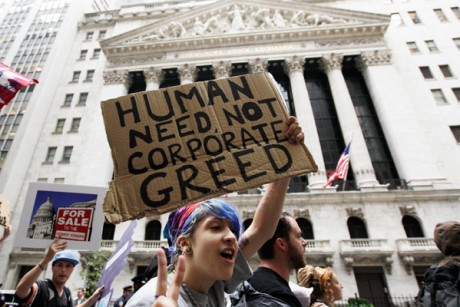
Over the past few months the world has seen unusually large numbers of people rising up, arguing that there is too much socioeconomic inequality, and furthermore, that money is infiltrating democracy leaving the big decisions in the hands of wealthy corporations. There is not merely a problem in theory with wealth and democracy, but as we shall see, it is a very serious problem in practice for democratic nation-states, now more than ever. The proposed mining super-profits tax is an example of where an advertising campaign by wealthy corporations was able to sway public opinion, arguably in a manner which was unhealthy for democracy.[12] In regard to the tax, The Australian provocatively asked the reader ‘How much does it cost to bring down a prime minister? The answer a tad over $22 million.’[13] It seems that the effect of the advertising was what Brighouse described as ‘subliminal manipulation that bypassed the rational capacities of the voter.’[14] He distinguishes this from coming to a decision ‘through a process of ratiocination in conditions of free and equal debate.’[15] While there were multiple factors at play in the ousting of Rudd and the dilution of the super-profits tax, it seems that in this instance, as predicted, the rich won.
Currently, the issue of how to best to tackle problem gambling is receiving attention in the Australian media after Independent Member Andrew Wilkie and Independent Senator Nick Xenophon proposed tougher regulation and limits on how much people can bet. Tim Costello, chairman of the Australian Churches Gambling Taskforce, argues that the $11.8 billion industry is in dire need of reform.[16] With four in every ten dollars coming from problem gamblers, it is understandable as to why change is unattractive to the industry. And while the industry have every right, as equals, to voice their concern, their voice should not be a roar which masks the possibility for progress. Unfortunately, this has been the case. Costello writes that Clubs NSW used ‘political donations to buy government access’ and that Clubs Australia has ‘mounted a sustained campaign of personal attacks’ against the politicians who suggested reform to current pokies legislation.[17] Similar to the campaign by the mining industry against Rudd’s proposed super-profits tax, Clubs Australia will do what they need to do to ensure that their shareholders are satisfied. As often happens when money enters into politics, this leads to an ‘ends justify the means’ scenario. Few of the most virtuous men or women can survive sustained, belligerent, personal attacks of an expensive marketing campaign. This is particularly harmful to democracy.
In summary, democracy is a good way of ensuring a basic standard of equality. However, as shown throughout this paper, there are different levels of democracy. The case studies above have shown that for true democracy to exist, and for correlative equality to come about, the government must ensure that the rich are not drowning out the poor and the working-class. An effective way of bringing this about is by ensuring that equality is a major focus of democratic institutions. This essay supports Myer’s proposition, that ‘government intervention in the economic realm is necessary for the promotion of equal freedom.’[18] True procedural equality cannot be achieved until the substantive problems adversely affecting it are fixed. Once these problems are fixed through better regulation and a higher priority on the supply of ideas rather than just demand, only then will we see the flow on effects from procedural equality.


Bibliography


[1] Singer, Democracy and disobedience, Oxford, 1973, p. 43.
[2] Myers, The politics of equality : an introduction, London; New York; New York, 2010, p. 34.
[3] Internet Encyclopedia of Philosophy, Jeremy Bentham, 2011.
[4] Green, Retrieving democracy : in search of civic equality, Totowa, N.J., 1985, p. 172.
[5] Verba and Nie, Participation in America: political democracy and social equality, New York, 1972, pp. 336-337.
[6] Brighouse, Egalitarianism and Equal Availability of Political Influence, 1996, p. 126.
[7] Christiano, Deliberative Equality and Democratic Order, New York, 1996, pp. 258-259.
[8] Green, Retrieving democracy : in search of civic equality, 1985, p. 177.
[9] Ibid., p. 178.
[10] Brighouse, Egalitarianism and Equal Availability of Political Influence, 1996, p. 120.
[11] Christiano, Deliberative Equality and Democratic Order, 1996, p. 252.
[12] Megalogenis, Trivial Pursuit: Leadership and the End of the Reform Era, 2010, p. 4.
[13] Davis, A snip at $22m to get rid of PM, 2011.
[14] Brighouse, Egalitarianism and Equal Availability of Political Influence, 1996, p. 126.
[15] Ibid., p. 126.
[16] Costello, Clubs use tricky numbers to outfox pokies reform, Sydney, 2011.
[17] Ibid.
[18] Myers, The politics of equality : an introduction, 2010, p. 83.