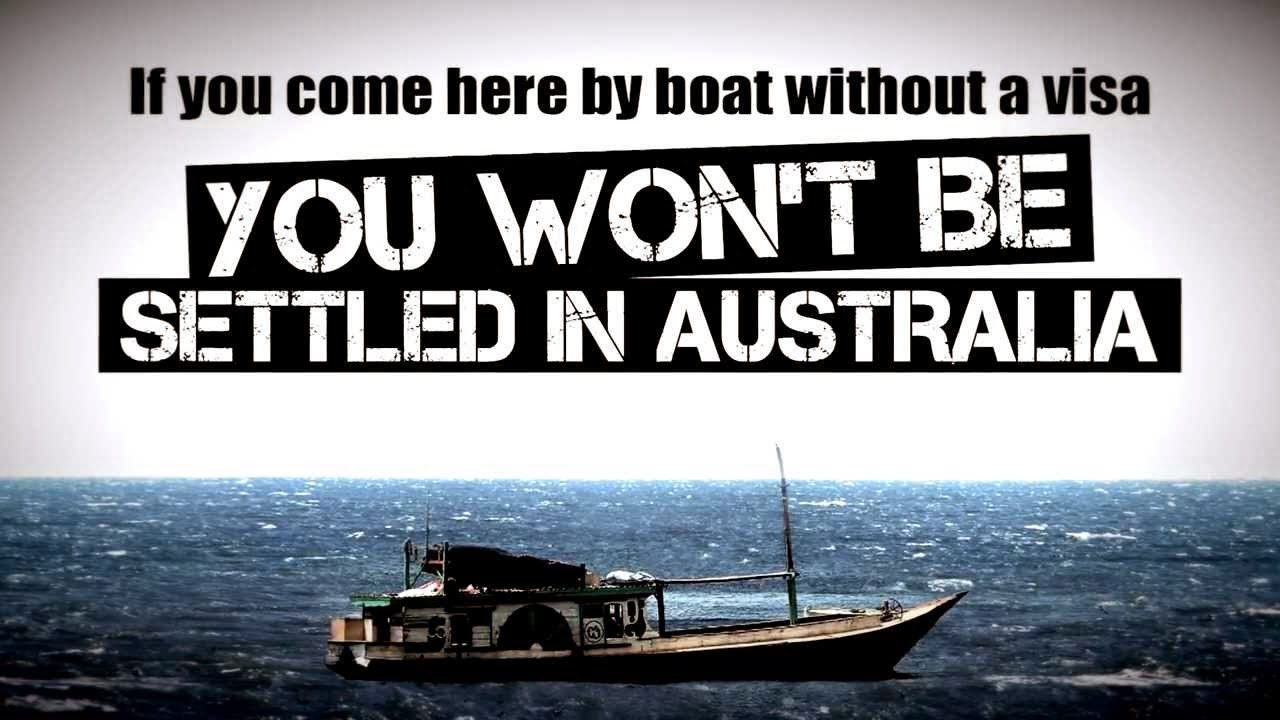
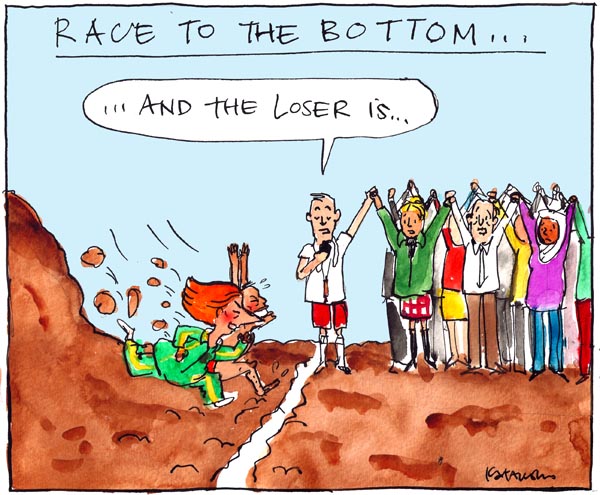
Showing posts with label refugees. Show all posts

Saturday, August 9, 2014

'Generosity Cap' : stepping towards a refugee solution

I have been involved in refugee advocacy for over three years. I have said a lot about what is morally wrong with how the state of Australia treats asylum seekers, and how the nation of Australia views them. I have also discovered that many on ‘my side’ of the fence, as it were, are somewhat more reluctant in putting forward a tenable ‘solution’, or at least a step in what we may believe is the right direction.

This is understandable as there are many contradictory ideological perspectives that can group together to attack how the state and nation view those seeking asylum. It is far easier to bond together on what we are against, rather than what we stand for. The reality is that those who are against the current treatment of asylum seekers do not all stand for the same thing, so we have grouped together around what unifies us.

Saul Alinsky says that ‘the price of a successful attack is a constructive alternative.' Many of us are terrified of the word ‘solution’, because its heritage in Australian political discourse makes it seem synonymous with ‘deterrence’ rather than something that actually addresses the reasons as to why people are seeking our protection.

So here is my first try at a ‘solution’. I think this is humane, realistic, and a step in the right direction.

Refugee Camp: Sven Torfinn for the Guardian


'Generosity Cap' : a refugee solution


7.5% of Australia’s gross population increase should be reserved for protection visas with a minimum of 30,000 to be granted each year. Currently Australia’s population is increasing by approximately 400,000 people each year. 30,000 is a reasonable figure - we need the numbers regardless.

An additional 10,000 places should be made available for permanent protection reunion visas, where a refugee in Australia can sponsor a family member when they have the means to independently support those who they are being reunited with.

It’s difficult to come up with a number like 30,000 or 7.5%. One way of looking at it is to first consider that Australia has about a 1% share of global wealth.  There are just over 50,000,000 refugees in the world. This means that Australia’s fair share is around 500,000. It is difficult to assess over how many years the 50 million refugees have been ‘produced’. The UNHCR reports that there were 10 million new refugees last year along. It would take us about 17 years to become host to over 500,000 first generation refugees or 13 years if we are to include reunion visas. 

It is worth noting that resettlement is not always the best option. Many refugees are looking for peace, not resettlement. It would seem that the 5 million Palestinian refugees are not all desiring resettlement in Australia. But for many of the 50 million refugees in the world, resettlement is their only option.

This intake can only be increased by individuals or communities committing to hosting an asylum seeker, or asylum seeker families for periods of at least 3 years. Those who are hosted for three years by members of the public will not count towards the 30,000 cap. This is a fair compromise between collective responsibility towards those in need and individual. This is a ‘cap’ that is determined by the generosity of Australian citizens.

Maximum 10,000 refugees can be resettled through arriving by boat or claiming protection once in Australian territory. Only those who are found to be genuine will be resettled. Once the 10,000 cap is reached, asylum seekers will be forced to relocate either back to their home country or to a regional refugee camp which is co-sponsored by the Australian government unless Australian individuals and communities are willing to commit to hosting them.

Those who arrive by boat and are found to not be genuine should have the right to appeal. If they are unsuccessful or choose not to appeal, they should be sent back to their home country where possible. In the rare cases that they are unable to be sent back, they should be given temporary residency in Australia.

The Australian government should once a year check on the status of those who have been sent back through a trusted humanitarian organisation over the course of five years. If it is found that forced deportations have resulted in those who were thought to have not been refugees being persecuted then this policy must be reconsidered.

At least 20,000 refugees from camps, primarily in the Asia-Pacific region should be resettled in Australia each year. This should lower the number of boat arrivals and drownings at sea. There should be incentives for employers to hire refugees so that they can become ‘economic contributors’ as soon as possible (acknowledging that various studies have shown that refugees are currently contributing greatly towards Australia’s economy).

The Australian government should invest in online infrastructure to make it simple for members of the public to be able to host refugee families during their initial resettlement in Australia.

What are your thoughts?

Saturday, November 16, 2013

Let's face it: We're probably racist.


Let’s face it. 

If New Zealand was under attack and boatloads of predominately white people from New Zealand came to Australia, our ‘stop the boats’ policy would change instantly. They wouldn't be sent to Nauru, Manus Island, or anywhere else with the promise of never being resettled. They wouldn't be perceived as a threat; as selfish individuals who have come to our country as economic opportunists. We wouldn't seek to deter ifrom asking for our help.

They would be welcomed.

If they were ten, twenty, or thirty percent of our net migration in a given year, we would not flinch. We would welcome support from governments, churches, and charities whether it be in solidarity or in substance. Our preachers would not preach hate. Our teachers would teach us to hear their stories. 

Our lives would be mutually enriched.

If they came to our country we would give them the right to work. We would allow them to have a dignified existence in our midst, and seek to know them in a deeper way than as ‘the other’. Ungracious metaphors would have no place in our language. They are not a flood, a drain, or a wave. They are people. They are real people. They have names. They have stories. They have suffered.

They would be heard. 

If they came to our country they would not see signs saying ‘go away, we’re full’, or ‘don’t like it? get out’. They would be encouraged to express their culture, to teach their histories, to share their food. They would not be looked upon suspiciously. There would be no neighbourhood alarm to ring when one of them steps foot on to a particular piece of land.

We would choose to embrace them.

Why would our reaction be different if they were from a predominantly white country? 

Because we are racist.

People who believe the spin that says ‘they’ have malintent and are out to get us are racist. People who think that asylum seekers fleeing persecution are somehow gaming the system are racist. People who think that suffering and vulnerable people who need our help should be shown the door are racist.

Let’s not use colourful ‘diplomatic’ language and call them ‘rationalists’, ‘conservatives’, or ‘patriots’. It’s time we called a spade a spade, a person a person, and a racist a racist.

Monday, August 6, 2012

Conversations with Amy Fitzpatrick about Christianity, Anarchism, and Structural Violence


The fifth episode in the 'I Am Instrumental: Peace Podcasts' series is a conversation with a friend of mind, Amy Fitzpatrick. Amy is a speech pathologist who currently lives and works in Perth. Amy believes that 'there's a real strength in nonviolence.' Also in this podcast, hear Amy talk about her views on Christianity, anarchism and violence.

Amy was a facilitator at the Pace E Bene 'Nonviolent Leadership for Interfaith Peacebuilders' course. You can register your interest in participating in this course in 2013 here:http://www.nonviolentinterfaithleadership.org/

'I have a lot of respect for people who stand up for what they believe in without intimidating others'

'As I started to read the Gospels much more closely, I began to realise how important nonviolence was to Jesus'

'I would like to live as simply as I can'

"Conversations with Amy Fitzpatrick about Christianity, Anarchism, and Structural Violence" by iaminstrumental is licensed under a Creative Commons License


Thursday, May 31, 2012

Singer and Rawls on International Justice


Compare the conception of international justice held by Peter Singer and John Rawls. Indicate which thinker’s conception is superior and why.

John Rawls and Peter Singer both hold to the view that society should be constructed in an egalitarian manner. In this essay I will explore the differing methodologies which Rawls and Singer use to develop their respective theories of international justice. I will argue that Rawl’s approach has stronger potential if the ‘difference principle’ were to be applied to the international justice sphere. I will also explore Singer’s theory and suggest that as they both stand, Singer provides a more responsible and egalitarian conception of international justice. Throughout this essay, I will work from the assumption that a philosophically consistent, egalitarian and responsible theory is superior to the alternative options.

First, I will briefly describe the core components of Justice as Fairness which is Rawls’ domestic conception of justice. A basic understanding of Rawls’ domestic conception of justice will help us better understand the potential of a Rawls-based conception of international justice. Rawls’ domestic understanding of justice applies primarily to how the ‘basic structure’ of society should be set out and regulated. The term constructivism can be appropriately applied to his theory as he considers justice ‘only as a virtue of social institutions.’[1] The two primary principles that Rawls seeks to fulfill are as follows: (i) an ‘equal right to extensive liberty compatible with a like liberty for all’, and (ii) that ‘inequalities are arbitrary unless it is reasonable to expect that they will work out for everyone’s advantage, and provided the positions and offices to which they attach, or from which they may be gained, are open to all.’[2] It is important to note that the second principle is not utilitarian (average or total) in the sense that disadvantaging the least well-off can be counterbalanced by advantaging the most well-off equal amounts. According to Rawls, if there is an inequality it must benefit all people including the least well-off. This will be referred to as the difference principle.

These principles are what Rawls believes a rational, risk-averse, and self-interested person would choose in the original position. According to Rawls, in the original position ‘no one knows his place in society, his class position or social status, nor does any one know his fortune in the distribution of natural assets and abilities, his intelligence, strength, and the like.’[3] He goes on to state that ‘the principles of justice are chosen behind a veil of ignorance.’ Behind the ‘veil of ignorance’ people are unknowing of particular factors which should when applied nullify ‘the accidents of natural endowment and the contingencies of social circumstance as counters in quest for political and economic advantage.’[4]

The aforementioned elements of Rawls’ thinking are to be applied in full to the domestic realm, yet, they are only granted limited applicability by Rawls in the international realm. The difference principle is especially relevant to my later discussion of the potential of a Rawlsian understanding of international justice. Law of Peoples is Rawls’ attempt to extend Justice as Fairness to the international sphere. He endeavors to develop a framework of international justice which is ecumenical, and one which is not partisan to ‘societies whose political institutions and culture are liberal.’ Rawls states that a ‘liberal society must respect other societies organized by comprehensive doctrines, provided that their political and social institutions meet certain conditions that lead the society to adhere to a reasonable law of peoples.’[5] He provides seven principles in regards to international relations which include respect for freedom and independence, equality among persons, rights to self-defense (but not aggression), duty of nonintervention, duty to observe treaties and undertakings, restrictions within war, and a duty to honor human rights.[6] While Rawls does suggest that there ‘should be certain provisions for mutual assistance between peoples in times of famine and drought’, his theory of international justice emphasizes restrictions rather than prescriptions; negative duties of justice rather than positive duties of distributive justice, like his domestic theory.[7]

Peter Singer, unlike Rawls, uses a moralist approach to support his arguments surrounding international justice. These arguments are not tied in with a social contract.[8] His views are broadly utilitarian, although, one could easily accept the argument he gives in Famine, Affluence, and Morality without having a commitment to utilitarianism. Singer begins with the assumption that ‘suffering and death from lack of food, shelter, and medical care’ are bad things. His argument then follows that ‘if it is in our power to prevent something bad from happening, without thereby sacrificing anything of comparable moral importance, we ought, morally, to do it.’ [9] The qualifier he uses in the strong version of the principle, ‘without thereby sacrificing anything of comparable moral importance’ (my emphasis) is particularly important. [10] Singer is essentially suggesting that we must give foreign aid to the point of marginal utility whereby to give any more resources would sacrifice something which of equal moral worth, either for us or our dependents. Following this principle to its logical conclusions would have radical implications for how many people, especially those of us who reside in richer nations, would have to live in order to be moral.

The principle is most simply articulated by the drowning child example which Singer provides in Famine, Affluence, and Morality. He puts forward the deceptively uncontroversial assertion that ‘if I am walking past a shallow pond and see a child drowning in it, I ought to wade in and pull the child out.’ Singer goes on to suggest that the distance between me and the child ‘makes no moral difference.’ Since Singer, like most practical philosophers, subscribes to principles of ‘impartiality, universalisability,’ and ‘equality,’ it seems reasonable to state that distance either makes very little difference or no difference at all in situations where people who have access to vast resources can easily support famine relief in places like Bangladesh. [11] He also refutes the argument that says ‘there are other people either equally or better placed to give money and this therefore exempts me from owing anything to the worlds’ poor.’ While it may be the case that there are people better placed than I to help, it is clear that many of those people have chosen not to address the problem and therefore the conclusion is based upon a hypothetical premise which presumes that the very rich will do all that they can to address poverty. As Singer points out, such an argument is ‘an ideal excuse for inactivity’ which does nothing to address the situation which we currently find ourselves in.[12]

The question regarding which author provides a better framework for dealing with poverty is a difficult one. I will argue that as their respective theories stand, Peter Singer provides a better theory in regards to international justice. However, if John Rawls took his theory of domestic justice as it is outlined in A Theory Of Justice and applied it consistently to the realm of international justice, his theory would be able to address poverty equally, if not better than Singer’s theory. There are two main reasons why Rawls’ theory of international justice is incomplete: (i) he attempts to synthesize liberal tolerance with prescriptive egalitarianism, and (ii) he effectively creates a morality based upon the social contract.

In order to gain ecumenical support, Rawls compromises and waters down many of the logical conclusions that one would reach if they were to apply the ‘veil of ignorance’ hypothetical scenario to shape international governance.  Rawls attempts to be tolerant with societies whose members may have different conceptions of justice than ours, and who may be guided by different kinds of comprehensive doctrines.[13] However, this apparent respect of ‘other societies organized by comprehensive doctrines’ effectively forfeits our social contract with them, meaning that there is no clear burden under the ‘veil of ignorance’ for a rational person to suggest that economic assistance must be given to poor people in illiberal nations. The rational person knows that she will not become a member of an illiberal society under the ‘veil of ignorance’ because the veil does not apply to illiberal societies. This then means that she has no good reason to make allowances for these people unless they will somehow improve her lot, which in many cases, is highly improbable.

The second objection to Rawl’s theory ties in strongly with the first objection. Rawls’ theory of international justice is based on the social contract. While any theory based upon the social contract should be first seen as contractarian rather than moral, it is unavoidable for a theory like Rawls’ to have many moral implications, imperatives, and restrictions. Strictly speaking, it is not immoral to decide under the ‘veil of ignorance’ that there will be a small portion of people who control a great deal of society’s wealth, this should be seen as irrational. However, making a decision under the ‘veil of ignorance’, then changing the decision when the veil is lifted, in favor of one’s self interest, could be seen as immoral. In short, Rawls’ theory has moral implications even though it is based on rationality. The morality drawn from Rawls’ theory could be summed up as ‘do unto others as they do unto me.’ This is unfortunate as any morality that gives an exemptions if other people choose not to follow it is flawed. Effectively, such a morality is dependent on the actions of another person rather than any deeply held conviction.

In Practical Ethics (Second Ed.) Singer argues that wealthy nations should be significantly more generous in their intake of asylum seekers, perhaps up until the point of marginal utility. He creates a scenario similar to the ‘drowning child’ thought experiment which was previously mentioned. Singer asks whether the investors in the hypothetical underground community called Fairhaven should allow non-investing people into their community, allowing them to escape the extreme radiation outside. Members of Fairhaven will have to give up their tennis courts, swimming pools, and their large gymnasium in order to give those outside some form of basic accommodation. Singer presents three options: (i) admit all 10,000 outsiders and lose all the sports and entertainment facilities, (ii) admit only 500 outsiders and lose a quarter of the tennis courts (which only had little use), or (iii) admit no outsiders and therefore accept no costs.[14] I find this to be a compelling argument for a more responsible and egalitarian approach to those fleeing persecution across borders. However, as a utilitarian, Singer is obliged to consider the consequences for all affected parties, which leads to a great deal of moral complexity when this issue could have been a simple matter. In the third edition of Practical Ethics, Singer removed the chapter Insiders and Outsiders, explaining why in the preface. He cites reasons such as the possibility of a ‘racist backlash’ if a country accepts large numbers of refugees as ‘highly relevant’ to the discussion, and no doubt, highly relevant to why he chose to omit this chapter in the third edition of Practical Ethics.[15] I find this argument to be both inconsistent with the Fairhaven hypothetical mentioned above and revealing of the limits of utilitarianism. If ‘racist backlashes’ are of genuine concern for Singer’s theory of international justice, his theory is little more than a Lifeboat Ethic.

As mentioned previously, and as noted by thinkers such as Pogge and Singer, Rawls’ main area of concern is the domestic sphere.[16] It is unfortunate that throughout The Law of Peoples, Rawls continually refers to the benefits of the ‘veil of ignorance’ only being conferred on to the citizen.[17] In a practical application of the ‘veil of ignorance’, as Rawls intends the device to be used, it seems inevitable that one would know that one will become a citizen of a liberal and democratic state, which would in turn justify self-interested and potentially deeply harmful policies towards outsiders. However, this goes against the very intention of the ‘veil of ignorance’ which aims to ‘nullify the effects of specific contingencies which put men at odds and tempt them to exploit social and natural circumstances to their own advantage.’[18] In Carens’ critique of Rawls, he points out that ‘whether one is a citizen of a rich nation or a poor one, whether one is already a citizen of a particular state or an alien who wishes to become a citizen – this is the sort of specific contingency that could set people at odds … We should therefore take a global, not a national view of the original position.’[19] Carens’ approach is ironically more compatible with the ‘veil of ignorance’ than the approach that Rawls himself utilised.

In conclusion, I find Singer’s theory of international justice to be superior to Rawls’, as Rawls intended his theory to be understood. However, if Rawls’ conception of domestic justice were to be applied to the international sphere, it would have the potential to be far more robust that Singer’s. The ‘veil of ignorance’, as it has been critiqued by authors such as Pogge and Carens, could be incredibly useful in the international realm, but only if it is applied with consistency.


Bibliography

Carens, Joseph H. “Aliens and Citizens: The Case for Open Borders.” The Review of Politics 49, no. 2 (April 1, 1987): 251–273.
Pogge, Thomas W. Realizing Rawls. Ithaca, N.Y: Cornell University Press, 1989.
Rawls, John. A theory of Justice. Oxford: Oxford University Press, 1973.
———. Collected papers. Edited by Samuel Richard Freeman. Cambridge, Mass.: Harvard University Press, 1999.
———. “Justice as Fairness.” The Philosophical Review 67, no. 2 (April 1, 1958): 164–194.
———. “The Main Idea of the Theory of Justice.” In Ethics, edited by Peter Singer, 362–367. Oxford; New York: Oxford University Press, 1994.
Singer, Peter. “Famine, Affluence, and Morality.” In World hunger and moral obligation, edited by William Aiken and Hugh LaFollette. Englewood Cliffs, N.J.: Prentice-Hall, 1977.
———. Practical Ethics. Second ed. Cambridge; New York: Cambridge University Press, 1993.
———. Practical Ethics. Third ed. New York: Cambridge University Press, 2011.
[1] John Rawls, “Justice as Fairness,” The Philosophical Review 67, no. 2 (April 1, 1958): 164.
[2] Ibid., 165.
[3] John Rawls, “The Main Idea of the Theory of Justice,” in Ethics, ed. Peter Singer (Oxford; New York: Oxford University Press, 1994), 363.
[4] Ibid., 365.
[5] Rawls and Freeman, Collected Papers, 540–541.
John Rawls, Collected papers, ed. Samuel Richard Freeman (Cambridge, Mass.: Harvard University Press, 1999), 532–531.
[6] Ibid., 540.
[7] Ibid., 540–541.
[8] In using the term ‘moralist’, I do not seek to suggest that Singer has political affiliations with groups who call themselves moralists. Rather, I am pointing out that his theory is directly speaking about what is right and wrong rather than what is rational and irrational.
[9] Peter Singer, “Famine, Affluence, and Morality,” in World hunger and moral obligation, ed. William Aiken and Hugh LaFollette (Englewood Cliffs, N.J.: Prentice-Hall, 1977), 24.
[10] Ibid.
[11] All quoted material in the beginning of this paragraph can be found in: Ibid., 24–25.
[12] Ibid., 25–26.
[13] Rawls, Collected papers, 530.
[14] Peter Singer, Practical Ethics, Second ed. (Cambridge; New York: Cambridge University Press, 1993).
[15] Peter Singer, Practical Ethics, Third ed. (New York: Cambridge University Press, 2011).
[16] Thomas W Pogge, Realizing Rawls (Ithaca, N.Y: Cornell University Press, 1989), 1–14; Singer, Practical Ethics, 253.
[17] Rawls, Collected papers, 537–541.
[18] John Rawls, A theory of Justice. (Oxford: Oxford University Press, 1973), 136.
[19] Joseph H. Carens, “Aliens and Citizens: The Case for Open Borders,” The Review of Politics 49, no. 2 (April 1, 1987): 256.

Tuesday, October 18, 2011

Welcome To Australia Community Forum


Featuring Jessie Taylor, Dr Gordon Preece, and Etervina Groenen.

Facebook RSVP

Asylum seeker issues are currently attracting a lot of attention in our media. The terms 'boat people', 'illegals', and 'queue-jumpers' are thrown around frequently. But who are these people? Where do they come from? Why are they leaving?

At the 'Welcome To Australia' community forum we will explore the moral and political issues surrounding the treatment of asylum seekers in Australia. You will get to express your views and ask questions of the panel (Tony Jones style, hopefully!). You can ask questions on the night, or you can submit them early on twitter with the hash tag #w2a.

This is a community forum which is open to all, whether you have been in Australia for 8 months or 80 years.

Speakers and Panellists:

:: Jessie Taylor
Jessie Taylor is a prominent lawyer and refugee rights activist. She is a member of The Justice Project board and is mentored by fellow board member Julian Burnside QC.

:: Dr. Gordon Preece
Dr Preece is the Director of Ethos and was the former Director of the Centre for Applied Christian Ethics (CACE) at Ridley

:: Etervina Groenen
Etervina is a refugee from East Timor who is now giving back and helping other refugees that come to Australia.


Time
19 November · 19:30 - 21:30

Location
2 Lum Road, Wheelers Hill, Victoria, 3150


Sunday, June 19, 2011

True inspiration

Image from a protest in Perth http://goo.gl/Sz7ga


This afternoon I went to the rally in Melbourne to end mandatory detention. Passing the anti-carbon tax rally, we eventually found our way there.

Julian Burnside spoke of the hypocrisy of Tony Abbott’s policies. Abbott, a self-identified Catholic, is more than happy to see vulnerable people used as political weaponry in a bid to gain votes. The logic behind offshore processing of asylum seekers is that it will exploit the vulnerable to stop more people from coming. Adam Bandt, the Greens member for Melbourne had this to say about the offshore processing "No one's ever accused me of being an economic rationalist before but what is very clear is that it [humane processing of asylum seekers] is also the cheapest alternative, when we have a government spending a billion dollars on offshore processing while we can't find enough money for schools and we're having to stop putting drugs on the PBS system.”[1] Why are we wasting money on mistreating people?

While I was listening to Bandt speak, I got talking with the lady next to me. She was holding a ‘We Welcome Refugees’ balloon… and also a walking stick. She told me how three of her grandparents were boat people from Europe. This lady had no problem with welcoming vulnerable people into our country, she even applauded it. Volunteering at the Asylum Seeker Resource Centre teaching English, she had really reconciled what her Catholic faith means for the treatment of ‘the least of these’.

At 85 years young, she had done well to make it to the rally. Her passion inspired me. She told me she wasn’t sure whether she would make it all the way, but she will stand up for the vulnerable for as long as she physically can. Inspiring.

So what makes you stand up? What makes you take action? What causes are worthy of your time?


[1] http://goo.gl/wwSLu

Friday, June 17, 2011

Why we cannot accept the Malaysia Solution

Recently, the Gillard-Labour government announced the ‘Malaysia Solution’. The deal proposes that the next 800 boat people to arrive on Australia’s shores will be sent to Malaysia. I won't delve into the details of the deal here, but rather focus on its ethical implications


      1.       We are taking vulnerable people and using them as a means to an ends to deter other people from taking the journey to our country.

This is a Kantian based concept, derived from deontology, yet it has been around much longer. Doing unto another, as one would do to oneself, has implications for the above statement. Why would I want someone to use me with no consideration to the effects that their actions will have on me? Is it ever justified to exploit one person to ‘save’ other people from taking the hazardous journey to Australia? I would suggest no, it is not. Whether we are doing it for our economic gain or for the safety of the next wave of boats, it is not ethical to use people as a means for the ends of other people with no consideration of that persons ends.

      2.      Rather than appealing to a good principle, we are using utilitarian methods to support this flawed scheme.

An appeal to the ‘greatest good’ as shown in statement above, in my mind, is completely misguided and very dangerous. Can we as Christians, or people who claim to be ethical, support the Malaysia solution when its appeal rests in its consequences? Paul thinks not. In Romans 3:8, some people suggested that Christians thought it was permissible for ‘us [to] do evil so that good may result’. Paul wrote that such ideas are slanderous. We are, as voters and as a country, doing evil so that ‘good’ will result by buying into this ‘solution’.

      3.      We’re treating some people better than others.

James (2:1) writes  'My friends, if you have faith in our glorious Lord Jesus Christ, you won't treat some people better than others'. He continues on to say treating some people better than others is a ‘sin’. If we are bible believers, we are walking on a tight-rope by arguing that it is permissible to treat a poor (if not materially, then otherwise) asylum seeker badly, and yet it is impermissible for the government to treat us (who are presumably richer – financially, security, etc.)  in the same manner. Our allegiance is not with nations, it is with the Kingdom.

I could go on about other implications, especially from a biblical point of view, but I won’t right now. From these three points I think it is clear that any policy that attempts to ‘stop the boats’ by harming innocent and vulnerable people is not one that can be supported by those who take morality seriously.

Make sure you check out Go Back To Where You Came From if you would like to get a more in depth and challenging experience of asylum seeker issues. It is a three part series that commences on Tuesday June 21, 8.30pm on SBS (Australia).

Monday, May 30, 2011

Asylum seekers in Australian political discourse

The media and politicians increasingly focus on the issue of ‘boat people’ and ways of ‘stemming the tide’ of arrivals.  While such arguments are often framed as campaigns as part of the battle against ‘people smugglers’, what do they reveal about the general trend of ‘criminalizing migration’ in our ‘securitized’ world?

Immigration and asylum has been politicised to the point where the politics of fear trumps our moral values in human rights. Security issues surrounding those seeking asylum, while important, tend to be derived from reactionary politics. Unfounded fears of a large number of asylum seekers claiming excessive Centrelink benefits and ‘ripping-off’ tax payers have been spread by Channel Nine News, Howard Sattler, and Alan Jones[1]. These fears have caused Australians to be less concerned with the plight of asylum seekers and how our government treats them. To add fuel to the flame of apathy, the Australian government has ensured that ‘no humanising images of asylum-seekers’ are to be shown to the Australian public[2]. This essay reviews the human cost of mandatory detention in conjunction with a hostile attitude towards those attempting to seek asylum on our shores. The ‘Children Overboard’ affair is just one event in a series of challenges in regards to immigration that Australia has faced. The Australian government’s reaction to the situation has displayed firsthand fear that is entrenched in public sentiment towards people arriving unannounced on our shores. This essay will contrast the political response to asylum seekers with the human face of the issue.

‘It was during the night. We didn’t know which way the shooting was going but the shooting was too much. [I was] vomiting, very scary, very sick and my daughter … too; my daughter very vomiting’.

These were the words of Ali Alsaai who was on board the Suspected Illegal Entry Vessel 4 (SIEV 4) [3]. This vessel carried 223 people, 76 of whom were children. On October 7, 2001, in the early hours of the morning, shots were fired in the water to deter SIEV 4 from proceeding towards Christmas Island[4]. The SIEV 4 had ignored several warnings from HMAS Adelaide asking the SIEV to turn back towards Indonesia. These requests were delivered in written and spoken form, and in ‘English, Bahasa and Arabic’ according to the Senate enquiry into the Children Overboard affair[5]. However, repeated requests for the SIEV to turn back towards Indonesia were ignored. Unaware of the heated political situation they were entering into, the passengers of  SIEV 4 were in the unfavourable circumstances of being intercepted by HMAS Adelaide less than 24 hours after then Prime Minister, John Howard, had called an election.

‘We will decide who comes to this country and the circumstances in which they come. And can I say on this point what a fantastic job Philip Ruddock has done for Australia’[6].

Only three weeks after SIEV 4 was shot at, Prime Minister, John Howard, fiercely asserted these words, soon to shape the slogan, ‘stop the boats’. When boat arrivals peaked in 1999, immigration minister Mr Ruddock described situation as ‘an assault on our borders’ to the scale of ‘a national emergency’[7]. The ‘fantastic job’ that Philip Ruddock had done was to create a sense of fear, appealing to public interest, in a bid to secure votes. This fear eventually led to John Howard being re-elected into the Australian parliament. Whether Mr Ruddock had done a ‘fantastic job’ for Australia, or whether he had done a ‘fantastic job’ for Mr Howard in preparing him for victory seems ambiguous. What is clear however, is that the Liberal government had not won a victory for human rights. This environment of cheap political victories ignored the human face of the asylum seeker crisis.

‘We could see their faces and the screaming was just horrific. They were yelling, ‘Help us!’ and, at one point, it was more deafening than the 50-calibre machine gun’[8].

These were the cold words of Able Seaman Laura Whittle who was on board the HMAS Adelaide as she fired shots towards SIEV 4. The task of her ship was to keep SIEVs out of Australian waters. Whittle admits that she was, at this stage, ‘not thinking about them as people’ and ‘largely indifferent to the asylum seekers’ fates’[9]. However, Whittle’s views were abruptly challenged when she saw a man holding his young daughter in his arms[10]. ‘It just made my heart melt’, Whittle recalled, ‘it was like the father was saying to our guys in the inflatable rafts, ‘take her, take her’ … it was then that I moved out of work mode and the humanity began to kick in’[11]. Whittle then thought, ‘how could somebody be so desperate to do something like this, to head towards the unknown with their children on a rickety boat and to put everything at risk? They must have been coming from something terrible and it made me think, this isn’t right, this isn’t how things should be’[12]. Prime Minister, John Howard, was adamant that children were thrown overboard and that he ‘certainly doesn’t want people of that type in Australia’[13]. However, Whittle saw no children being thrown overboard, and nor did anyone else for that matter[14].  Whittle’s account of the events of October 7, 2001, provide a valuable insight into the void between reality and populous politics.

‘During my visit to immigration detention centres in Darwin, I saw the grim despondency of asylum seekers waiting months and in some cases well over a year to be released. These people who arrive with such relief and hope after experiencing trauma in their home countries, should not be treated this way’[15]

Navi Pillay, the United Nations High Commissioner for Human Rights during her recent visit to Australia in May 2011, argued that we should not be treating asylum seekers in the way that we currently do. In an interview on ABC’s PM she called on the ‘leaders of all Australia’s political parties’, asking them to ‘take a principled and courageous stand to break the ingrained political habit of demonising asylum seekers’[16]. Unfortunately, this was a very idealistic ask of Australian political culture, as Kevin Rudd’s attempt at ‘humanely’ treating asylum seekers was a factor in his downfall. In Rudd’s bid to gain power leading up to the 2007 election, he wrote an essay ‘Faith in Politics’, outlining his perspective on how these subjects are interrelated. He wrote ‘the biblical injunction to care for the stranger in our midst is clear. The parable of the Good Samaritan is but one of many which deal with the matter of how we should respond to a vulnerable stranger in our midst’[17]. Journalist Robert Manne commented in 2008 that Rudd’s asylum seeker policy was ‘morally admirable but politically perilous’[18]. Rudd would in turn pay a heavy price for his ‘humanitarian stance’ on asylum seekers as it was viewed as a loss of control of our borders. Julian Burnside QC, in 2002, argued that mandatory detention was a ‘breach of our obligations under international conventions’. However, in the nine years since this statement was reported, attempts by former Prime Minister Rudd and others seem to have done little to aid the situation[19].

‘She’d tied a sheet to the ceiling, swallowed a bottle of shampoo, then put her head in the makeshift noose. When the guards managed to break the door down, her parents and seven-year-old brother found her lying in a sea of vomit, her face translucent with death.’[20]

The story of Amy, at only nine years of age, is the horrifying result of mandatory and indefinite detention in Australia. Repeated recommendations were issued for Amy’s immediate release, including one from an ‘expert psychiatrist’. However, these recommendations were ignored. Mr Ruddock also ignored an urgent child protection notification asking the government to grant Amy and her family temporary protection visas. Amy’s family were part of a persecuted Christian minority fleeing from their country. Her father was escaping execution on fabricated charges, managing to ‘bribe his way out of prison, sell the family’s entire belongings and pay people smugglers to get them to Indonesia’[21]. It has been suggested that Australia’s detention system has been ‘designed to induce mental trauma’[22]. For Amy, and many other detainees, this seemed to be the case. Amy’s story was reported less than a year after former Prime Minister John Howard congratulated Philip Ruddock on the ‘fantastic job’ he was doing for Australia. In another case, a World Vision employee, Amin Jan Amin, was locked up in detention on Nauru. According to refugee Sajjad Sarwari, Nauru is not even worthy of being called a detention centre. He described Nauru as a ‘hellhole’ and expressed his concern for those who are still there to a reporter from The Age[23]. Tim Costello, on the day he became chief executive officer of World Vision Australia, wrote to the immigration minister confirming Amin’s identity and his good character as described by his AusAid program manager. It was not until several months later Amin Jan Amin was released from Nauru and issued a temporary protection visa[24]. The inhumane treatment of Amin Jan Amin, as well as Amy and her family are the sickening consequences of populous politics. It is important to note that both Amin Jan Amin and Amy considered themselves to be Christian, in some ways ‘like us’ (or more ‘like us’ than other immigrants), and yet, they were still treated inhumanely. Amy was a child, at just nine years old, while Amin Jan Amin was a fondly remembered World Vision employee, yet still these attributes were not enough. It leaves one wondering how bleak seeking refuge in Australia must look for those who are of other faiths, those who are of age, and those who don’t work for internationally respected non-government organisations (NGOs). In attempt to ‘criminalise’ migration we have put hand-cuffs on the vulnerable and marginalised.

‘There is an undeniable linkage between illegals and terrorists’[25]

Peter Slipper, a Liberal Party MP, asserted this statement only weeks before an anti-terrorist squad was sent onto SIEV 4 (‘Children Overboard’). However, Adrian D’Hage, a former defence official saw the situation differently: ‘It is not a matter of national security when asylum seekers are picked up.  These are unarmed civilians’, he told ABC’s Lateline[26]. William Maley, the director of the Asia-Pacific College of Diplomacy, also disagreed with Peter Slipper. Maley suggests that it is ‘relatively’, perhaps even ‘absurdly’ easier to enter Australia on a tourist visa rather than on a boat. Willy Brigitte, a French passport holder with terrorist ties did not travel on a leaky boat to Australia, but rather, he came by plane on a tourist visa[27]. However, the fear of a terrorist slipping through the nets is still rife in Australia. 

‘If I talk to an Australian I will ask this question, ‘You are a citizen of this country, you are its conscience. You teach your children respect of human rights and to support civil rights. Please treat others, as you would like to be treated.’[28]

It is clear that our ‘tough stance’ on those seeking asylum, especially those who come on boats, is derivative of fear which has been invented by particular individuals and groups in order to satisfy their self-interest. Our policies on asylum seekers are sometimes developed in the name of ‘humanitarianism’, aimed at taking a hard line approach to people smugglers by locking up the victims. The so-called ‘security threat’ that asylum seekers present has been shown in this essay to be a political convenience rather than a truthful claim.


Bibliography


[1] Media Watch, Welfare and Refugees, 2009.
[2] Brennan, Just words? : Australian authors writing for justice, St Lucia, Qld., 2008, p. xiii.
[3] Briskman, Goddard and Latham, Human rights overboard : seeking asylum in Australia, Carlton North, Vic., 2008, p. 33.
[4] Commonwealth of Australia, Chapter 3 - The ‘Children Overboard’ Incident: Events and Initial Report, Canberra, 2005, section 3.13.
[5] Ibid., section 3.9-3.11.
[6] AustralianPolitics, John Howard's Policy Speech, 2001.
[7] Mares, Borderline : Australia's treatment of refugees and asylum seekers, Sydney, Australia, 2001, p. 28.
[8] Leser, Children Overboard: Two Women, Two Stories, 2007, p. 79.
[9] Ibid., p. 79.
[10] Ibid., p. 79.
[11] Ibid., p. 79.
[12] Ibid., p. 79.
[13] Kelly, Govt wrong on asylum seeker allegations, 2002.
[14] Australian Broadcasting Corporation, Navy gunner breaks silence on SIEV IV, 2004.
[15] Australian Broadcasting Corporation, UN commissioner still critical of Malaysia deal, Sydney, 2011.
[16] Ibid.
[17]Rudd, Faith in politics [Christian ethics and the State.], 2006, p. 29.
[18] Manne, Comment: Asylum Seekers, 2010, p. 11.
[19] Leser, Behind the wire, 2002, p. 45.
[20] Ibid., p. 44.
[21] Ibid., p. 44.
[22] Frow, Unaustralia : strangeness and value [Paper in: Slight Anthropologies. Frow, John and Schlunke, Katrina (eds).], 2007, p. 41.
[23] The Age, Baghdad, Nauru, Wellington: taking the long way home, Melbourne, 2004.
[24] Gordon, Freeing Ali : the human face of the Pacific solution, Sydney, 2005, pp. 45-49.
[25] Kelly, Howard's electoral fortunes turn around, 2001.
[26] Jones, Children overboard affair hits military moral, 2002.
[27] Maley, Fear, Asylum, and Hansonism in Australian Politics, 2010, pp. 11-13.
[28] Austin, From nothing to zero : letters from refugees in Australia's detention centres, Melbourne, Vic.; London, 2003, p. 137.