Monday, November 7, 2011

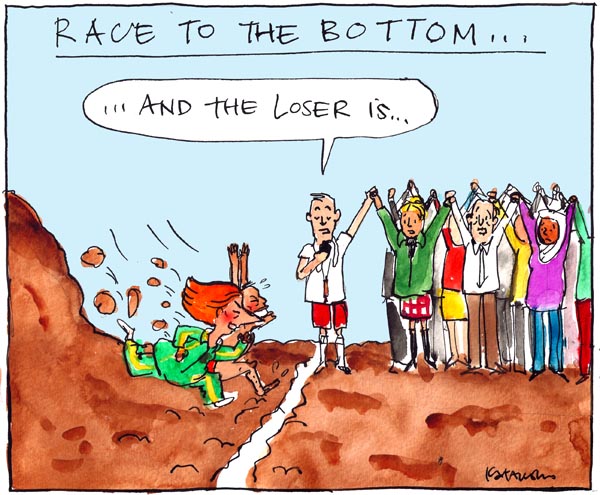
Hollow be thy name.


Our Father, which art in heaven,

Hollow be thy name.

Thy Kingdom leave.

My will be done in heaven,

As it is on earth.

Grant us our oppressed,

As we oppress those who seek refuge among us.

And lead us not into humility,

But deliver us from fraternity.

For mine is the kingdom,

The power, and the glory,

Forever and ever.

Amen.


Who is the centre of your belief?

Tuesday, October 18, 2011

Welcome To Australia Community Forum


Featuring Jessie Taylor, Dr Gordon Preece, and Etervina Groenen.

Facebook RSVP

Asylum seeker issues are currently attracting a lot of attention in our media. The terms 'boat people', 'illegals', and 'queue-jumpers' are thrown around frequently. But who are these people? Where do they come from? Why are they leaving?

At the 'Welcome To Australia' community forum we will explore the moral and political issues surrounding the treatment of asylum seekers in Australia. You will get to express your views and ask questions of the panel (Tony Jones style, hopefully!). You can ask questions on the night, or you can submit them early on twitter with the hash tag #w2a.

This is a community forum which is open to all, whether you have been in Australia for 8 months or 80 years.

Speakers and Panellists:

:: Jessie Taylor
Jessie Taylor is a prominent lawyer and refugee rights activist. She is a member of The Justice Project board and is mentored by fellow board member Julian Burnside QC.

:: Dr. Gordon Preece
Dr Preece is the Director of Ethos and was the former Director of the Centre for Applied Christian Ethics (CACE) at Ridley

:: Etervina Groenen
Etervina is a refugee from East Timor who is now giving back and helping other refugees that come to Australia.


Time
19 November · 19:30 - 21:30

Location
2 Lum Road, Wheelers Hill, Victoria, 3150


Monday, October 10, 2011

Martin Luther King and the Civil Rights Movement

Martin Luther King meets Malcolm X


Martin Luther King, Jr. was one of the most influential figures in the American civil rights movement. King took a principled approach to his leadership rather than a populist approach. While the movement gave King the opportunity to lead, his leadership style differed greatly from other public leaders of his time. He developed many unpopular public positions including denouncing the Vietnam War and proposing non-violent solutions to various problems in society. King had more enemies and was more controversial than the history books often portray. One of King’s close friend’s believes that ‘those on the right breathe deeply and polish King’s rough edges into a more acceptable and harmless national icon.’[1] This essay explores the difficult and unpopular decisions that King made in order to be philosophically consistent in his leadership. Rather than appeasing the demos, King sought to express his deep conviction about poverty, justice, and racism.

King began his leadership of the Montgomery Improvement Association (MIA) reluctantly. He had previously refused leadership roles in the National Association for the Advancement of Coloured Peoples (NAACP) citing family and church obligations. In response to the offer of leadership within the MIA, he surprised his colleagues and said, ‘well, if you think I can render some service I will.’[2]  At this stage of his career King had only recently received his PhD in systematic theology, and he had passed up academic jobs to pursue this vocation. King wrote that he was ‘possessed by fear’ that he would not be able to carry it off and was ‘obsessed by a feeling of inadequacy.’[3] Even at this early stage of his career it is noticeable from records of King’s sermons at Dexter Avenue Baptist Church that he did in fact have a strong conscience and articulate expression, priming him for leadership in this area of moral and social change. King, before he received work at Dexter Avenue Baptist, courageously told the congregation at a ‘trial’ sermon that ‘no man should become so involved in his personal ambitions that he forgets that other people exist in the world.’[4]

However acute his moral conscience was, King was by no means responsible for initiating the American civil rights movement. King was effectively thrown into the position of presidency of the MIA as a communal response to the arrest of Mrs Rosa Parks who was charged with ‘refusing to obey orders bus drivers [sic].’[5] She was ordered to give up her seat for a white person yet she refused. King led a mass boycott of the Montgomery bus services in response to the protest of civil disobedience by Rosa Parks.[6] Soon after, King was chosen to be president of the MIA, he fully realised his vocation - standing up for justice, truth, and righteousness.[7] King’s passion and drive for the cause of civil rights in America was unwavering from this point onwards (January 27, 1956, to be precise). Three days later his house was bombed yet still his passion did not subside. To the large crowd of ‘angry black citizens’ King said ‘I want you to love our enemies. Be good to them. Love them and let them know you love them.’[8]

King was able to personify and embody, in this moment, the philosophy and theology that inspired him and the movement which he led. Through his courageous leadership in Montgomery, King proved that he lead on principle rather than popularity, which explains why he later refused to go into public office. The non-violence that King preached would now be responsible for shaping a movement and avoiding a civil war. King decided to wage the war on racism and segregation on moral grounds through non-violent means. King’s moral convictions led him to state: ‘frankly, I am for immediate integration. Segregation is evil, and I cannot, as a minister, condone evil.’[9] This utterance was in a similar vein to another American revolutionary, William Lloyd Garrison, who in 1831 decided that ‘it was immoral to favour the continuance for an hour of a system which is morally wrong’ and therefore did not support the gradual improvement to an evil system.[10] Anything else would be a compromise.

Malcolm X’s leadership of the black Muslims has proved to be one of the most interesting points of comparison to King’s leadership role in the movement. Although both leaders sought similar ends, they attempted to achieve those ends through means which were diametrical opposed.[11] Malcolm X sought unification on the understanding that black Americans have a common enemy – white men. He told his followers to ‘put the white man out of our meetings, number one’, so that blacks could present a unified front. Malcolm X, in a television interview described King as ‘the best weapon that white man, who wants to brutalize negroes, has ever gotten [sic] in this country, because he is setting up a situation where, when white man wants to attack Negroes, they can’t defend themselves.’[12] In a telegram to King, Malcolm X offered armed troops to aid his struggle in attempt to sway King from his commitment to non-violence. The telegram concluded: ‘the day of turning the other cheek to those brutes is over.’[13] This drew the key philosophical distinction between the two leaders of the civil rights movement.

In Message To Grassroots Malcolm X questioned: ‘How can you justify being nonviolent in Mississippi and Alabama, when your churches are being bombed, and your little girls are being murdered, and at the same time you’re going to [sic] violent with Hitler, and Tojo, and somebody else that you don’t even know?’ Malcolm X used the international analogy to point out the inconsistency of King’s position.[14] He had ran out of patience for King’s nonviolent direct action. Malcolm X summed up: ‘if violence is wrong in America, violence is wrong abroad’.[15] In saying this, Malcolm X used international violence to justify domestic violence. King would later speak out against the war in Vietnam and use domestic nonviolence to justify international nonviolence.

King disagreed with the means that Malcolm X sought to utilise to achieve higher status of black Americans. King believed that the value of an action should be found in the action itself, not in the outcome, writing that ‘immoral means cannot bring about moral ends’.[16] King describes non-violent resistance as ‘the most potent weapon available to oppressed people in their struggle for freedom and human dignity’, arguing that it ‘weakens his morale’ and ‘works on his conscience.’[17] For King, non-violence was the appropriate moral means to achieve the sought-after end. This philosophical belief was deeply inspired by King’s strong religious convictions and also by his visit to India. In India, King learnt about the movement which Gandhi led. After this visit King was even more confident that the struggle could only be won through non-violent means. One of King’s friends goes so far as to say that ‘Gandhi and Dr King were cut from the same cloth, long-lost brothers from different mothers.’[18] The means that King employed to pursue his passion are crucial for understanding him as a leader of the civil rights movement. King’s principles almost always trumped his desire for the best outcome or any desire for popularity. This is what separated King from many other leaders at the time.

King received two layers of criticism because of his strong convictions. Heated criticism was received within his own ranks as well as from outside observers, particularly the media. Within his own ranks, many activists working with King did not share his strong convictions of nonviolence, or they did so arbitrarily. Andrew Young, a friend and supporter of King only implemented nonviolence ‘because it was a practical solution’ and because ‘machine gunning down someone at a lunch counter or in a bus wouldn’t have been good public relations.’[19] The strongest of criticisms, however, only came to surface once King had spoken out against America’s role in Vietnam. Young, and some of King’s other friends were against King taking a public stance on Vietnam because it ‘would confuse the issue of civil rights with a non-relevant international military dispute.’[20] King, however, decided to follow his conscience and publically state that the Vietnam War was a ‘blasphemy against all that America stands for.’[21] King provoked a strong reaction from the media with one Washington Post reporter alleging that King’s speech against America’s role in Vietnam ‘was filled with bitter and damaging allegations and inferences that he did not and could not document’. The reporter went on to suggest that ‘many who have listened to him with respect will never again accord him the same confidence. He has diminished his usefulness to his cause, to his country and to his people.’[22] Others suggested that King should ‘stick to his own knitting’, and that he was ‘pandering to Ho Chi Minh.’[23]

King’s public stance on Vietnam proves an element of consistency in his views. It is clear that King spoke out against the war because of his deep conviction. He believed that this was the right thing to do, regardless of whether it would have a negative impact on the civil rights movement which he worked tirelessly to build. Even before he consulted others in the movement, Clark, a close friend of King felt ‘it was clear that Martin had already made his own decision to state publically … his anti-Vietnam war position.’[24] This is yet another example of King’s conscience driven leadership. King was often encouraged by his peers to enter politics, but he felt that elected officials ‘had to represent the majority’, whereas King ‘wanted to be a voice for the voiceless.’[25] King did not have a desire to represent the views of others, but to lead in a way that would ensure that the oppressed are listened to. When King spoke out against Vietnam, the Washington Post reported that ‘73% of American people disagree with Dr. Martin Luther King, Jr. in his denunciations of the war in Vietnam and 60 per cent believe his position will hurt the civil rights movement.’[26] Reverend Tim Costello, the CEO of World Vision Australia, who was inspired by King, believes that unpopular decisions in leadership are some of the most important. For the same reasons as King, Costello also decided not to enter public office on a federal level citing that he would have to follow the people if he is their democratically elected leader. Like King, Costello prefers the role of the prophet, suggesting that the ‘prophet is one who is prepared to go against where the people are going, even in the opposite direction because it’s right.’[27] King’s principled approach to morality provoked strong criticism, even to being labelled a ‘sell out’ by Malcolm X.[28] This criticism did nothing to weaken King’s convictions.

When considering whether the movement made King, or whether King made the movement, it is important to note that King did not happen to be a minister of the gospels by sheer chance. King’s father, grand-father, great grand-father and father’s brother were all pastors.[29] It almost seems as though King was destined for his role in the church. However, as a person representing an economically and socially marginalised group of society, King would have needed a great deal of persistence and motivation to achieve in the way he did.

As King’s profile increased to celebrity status, attempts to assassinate his character also augmented greatly. Not only was criticism directed at King from the media, but now it was also being sent from government organisations. FBI Director J. Edgar Hoover described King as ‘the most notorious liar in the country’, in attempt to destroy his platform.[30] The joint smear campaign by the FBI and the media was unable to crush King’s spirit. Until the day King was assassinated he spoke out against the evils which confronted him.

It is clear that King went well above what was expected from him in his role as a pastor. While he was a ‘good candidate’ for a leadership role in the American civil rights movement, he did not gain his status through sheer luck. Years of study, dissatisfaction with the status quo, and strong stances on public moral issues meant that King was well placed to lead the movement he propelled. While external environmental factors such as the movement itself were important parts of King’s leadership, it is clear that he embodied many great leadership qualities in and of himself. The distinction between the philosophies of Malcolm X and Martin Luther King which have been explored in this paper have shown how Malcolm X followed the mood of disenfranchised black Muslims in America while King took unpopular decisions in accordance with his conscience which turned him into a leader. All leaders have a relationship with those they lead, however, only few leaders have the ability to make difficult and unpopular decisions in order to act morally. King was one of few leaders who led like an unwelcome prophet.
                                                                                    

Bibliography


[1] De Leon, Leaders from the 1960s : a biographical sourcebook of American activism, Westport, Conn., 1994, p. 123.
[2] Albert and Hoffman, We shall overcome : Martin Luther King, Jr., and the Black freedom struggle, New York, 1993, pp. 14-15.
[3] Ibid., p. 15.
[4] Martin Luther King, The Dimensions of a Complete Life, Montgomery, 1954.
[5] Albert and Hoffman, We shall overcome : Martin Luther King, Jr., and the Black freedom struggle, 1993, p. 14 and Montgomery Police, Arrest report for Rosa Parks, Montgomery, 1955.
[6] De Leon, Leaders from the 1960s : a biographical sourcebook of American activism, 1994, p. 118.
[7] Martin Luther King, Why Jesus Called A Man A Fool, Chicago, 1967.
[8] Albert and Hoffman, We shall overcome : Martin Luther King, Jr., and the Black freedom struggle, 1993, pp. 20-21.
[9] Ibid., p. 17.
[10] Crosby, Garrison, the non-resistant, Chicago, 1905, pp. 15-16.
[11] One may be at liberty to argue that their ends were in fact of important difference. Malcolm X was not seeking integration but better treatment of the class in general, while King saw integration of whites and blacks to be a primary objective of the civil rights movement.
[12] Clark, King, Malcolm, Baldwin : three interviews, Middletown, 1985, p. 43.
[13] Malcolm X, Telegram from Malcolm X, 1964.
[14] Note: Malcolm X released these comments prior to King’s public stance on Vietnam.
[15] Malcolm X, Message to Grassroots, 1963. Note: I have taken to liberty to presume that this is an attack at King’s public position of the issues. However, it must be noted that Malcolm’s Message to Grassroots was not written to or for King as far as I can tell from my research. It does seem plausible that the attack on King’s beliefs were designed to ensure that Malcolm’s followers could be convinced of their position.
[16] Martin Luther King, Methodist Student Leadership Conference Address, Lincoln, 1964
[17] Clark, King, Malcolm, Baldwin : three interviews, 1985, p.23.
[18] Young and Sehgal, Walk in My Shoes : Conversations between a Civil Rights Legend and his Godson on the Journey Ahead, New York, 2010, p. 199.
[19] Ibid., pp. 196-197.
[20] Clark, King, Malcolm, Baldwin : three interviews, 1985, pp. 8-9.
[21] Post, Civil Rights Leaders Rapped on Vietnam, 1966.
[22] The Washington Post, A Tragedy, 1967.
[23] Post, Civil Rights Leaders Rapped on Vietnam, 1966, and The Washington Post, Veterans Accuse King, 1967.
[24] Clark, King, Malcolm, Baldwin : three interviews, 1985, p. 9.
[25] Young and Sehgal, Walk in My Shoes : Conversations between a Civil Rights Legend and his Godson on the Journey Ahead, 2010, p. 165.
[26] Louis, King's Viet War Stand Called Wrong by 73%, 1967.
[27] Talking Heads, Interview with Tim Costello, 2009.
[28] Clark, King, Malcolm, Baldwin : three interviews, 1985, p. 43.
[29] Albert and Hoffman, We shall overcome : Martin Luther King, Jr., and the Black freedom struggle, 1993, pp. 18-19.
[30] De Leon, Leaders from the 1960s : a biographical sourcebook of American activism, 1994, p. 120.

Monday, September 12, 2011

Garrison's 'Declaration of Sentiments'

This is a really powerful piece of writing, which I analysed for university. It has really challenged me, and I encourage you to read it also. It is short, readable, and interesting. This guy inspired William Wilberforce, Leo Tolstoy, and others. Check it out here: http://goo.gl/S7J1E

The message that Garrison sent to the Boston Peace Convention in 1838 was clear: ‘we cannot acknowledge allegiance to any human government, neither can we oppose any such government by resort to physical force’. [1] Purporting a strong pacifistic claim, Garrison’s view is that force may never be used, whether for good or for evil, by the oppressed or the oppressor. He believes this because of his conviction: that man can only serve one master, God, and therefore cannot serve any human government. Passion is embodied in his prose, having written the entirety of the ‘Declaration of Sentiments’ in a single afternoon.[2] According to Garrison, ‘nothing is plainer’ than the view that the use of physical force to punish an evil-doer is forbidden by the teachings of Christianity.[3]

Living within the moral law is crucial for Garrison, as it was in Kant’s moral philosophy. Garrison’s views are reflective of a strand of deontology which suggests that one should do what is right, come what may. However, Garrison also supports a peculiar appeal to consequentialism suggesting that the only way to triumph over evil is through doing good. Essentially he is suggesting that the results would be worse if one were to break the (moral) law to achieve what one thinks may lead to better consequences. This is not, however, strictly an appeal to the afterlife. Garrison’s view is that violence is intrinsically bad and therefore can never be a tool to bring about better consequences.

Garrison applies a consistency test to his ideas, suggesting that if we allow ourselves to use force in order to secure a good of some kind, we must also grant the same license to other individuals, states, and governments.  However idealistic, this test carries moral and intuitive weight because if we, as well as our enemies, were to apply the same principles, everyone would be better off.

In addition to putting forward arguments supporting pacifism, Garrison also is in favour of anarchism. He writes against all forms of human government claiming that ‘laws are enforced virtually at the point of the bayonet’.[4] Garrison argues that forcing men to do what it right ‘on pain of imprisonment or death’ is in conflict with his highly held ideals of forgiveness and love for ones enemy. Therefore, his philosophy (and religion, he argues) compels him to rebuke human governments so long as they require force to continue to exist.

The author’s opinions are based on a belief which does not have ‘universal’ support in any sense, but one which has had great influence in his country. Regardless of whether or not you choose to accept the Christian bible as truth, it is important to note that the leaders of America in the 19th century mainly associated with the Christian Protestant tradition. It seems conceivable that Garrison is simply asking what Martin Luther King Junior was to ask of America a century later: ‘be true to what you said on paper’.[5] Garrison reveals a deep passion for his ideals of non-violence and righteousness in the ‘Declaration of Sentiments’.


[1] Silverman, American radical thought : the libertarian tradition, Lexington, Mass, 1970, p. 144.
[2] Villard, Garrison and Tolstoy, William Lloyd Garrison on non-resistance; together with a personal sketch, New York, 1972, p. 23.
[3] Ibid., p. 22.
[4] Silverman, American radical thought : the libertarian tradition, 1970, p. 145.
[5] Martin Luther King, I've Been to the Mountaintop, Memphis, 1968.

Wednesday, August 3, 2011

Revelations

I wrote this song after reading an article by Tim Foster that I recommend you check out if you get the chance. 


Revelations
June 16, 2011
9:21 PM 16/06/2011
Christiansz
Capo 2

Verse 1

Is this just the way we're programmed or how we're meant to be?
For what purpose do we surface spreading our disease?
The claim is empirical and the findings spark belief
The motives for our actions must be something more than me

Have we captured our future selves, foreshadowed by our deeds?
How can love come of evil when people are our means?
Are we more than vessels in a cumulative sea?
Adding to the question of what being really means.

Chorus
The world is waiting, for transformation
A new beginning, REVELATIONS
Kingdom descending, the broken mending
Our hearts are anchored, in REVELATIONS

Verse 2
The ontology of biology is more than meets the eye
It's when the consciences of creatures suddenly come alive
Living in a vacuum of all that i can hide
Forbearing every weakness with an disembodied guise

Chorus
The world is waiting, for transformation
A new beginning, REVELATIONS
Kingdom descending, the broken mending
Our hearts are anchored, in REVELATIONS

Bridge
Your will be done
Your Kingdom come
Your will be done
Your Kingdom come


Sunday, June 19, 2011

True inspiration

Image from a protest in Perth http://goo.gl/Sz7ga


This afternoon I went to the rally in Melbourne to end mandatory detention. Passing the anti-carbon tax rally, we eventually found our way there.

Julian Burnside spoke of the hypocrisy of Tony Abbott’s policies. Abbott, a self-identified Catholic, is more than happy to see vulnerable people used as political weaponry in a bid to gain votes. The logic behind offshore processing of asylum seekers is that it will exploit the vulnerable to stop more people from coming. Adam Bandt, the Greens member for Melbourne had this to say about the offshore processing "No one's ever accused me of being an economic rationalist before but what is very clear is that it [humane processing of asylum seekers] is also the cheapest alternative, when we have a government spending a billion dollars on offshore processing while we can't find enough money for schools and we're having to stop putting drugs on the PBS system.”[1] Why are we wasting money on mistreating people?

While I was listening to Bandt speak, I got talking with the lady next to me. She was holding a ‘We Welcome Refugees’ balloon… and also a walking stick. She told me how three of her grandparents were boat people from Europe. This lady had no problem with welcoming vulnerable people into our country, she even applauded it. Volunteering at the Asylum Seeker Resource Centre teaching English, she had really reconciled what her Catholic faith means for the treatment of ‘the least of these’.

At 85 years young, she had done well to make it to the rally. Her passion inspired me. She told me she wasn’t sure whether she would make it all the way, but she will stand up for the vulnerable for as long as she physically can. Inspiring.

So what makes you stand up? What makes you take action? What causes are worthy of your time?


[1] http://goo.gl/wwSLu

Friday, June 17, 2011

Why we cannot accept the Malaysia Solution

Recently, the Gillard-Labour government announced the ‘Malaysia Solution’. The deal proposes that the next 800 boat people to arrive on Australia’s shores will be sent to Malaysia. I won't delve into the details of the deal here, but rather focus on its ethical implications


      1.       We are taking vulnerable people and using them as a means to an ends to deter other people from taking the journey to our country.

This is a Kantian based concept, derived from deontology, yet it has been around much longer. Doing unto another, as one would do to oneself, has implications for the above statement. Why would I want someone to use me with no consideration to the effects that their actions will have on me? Is it ever justified to exploit one person to ‘save’ other people from taking the hazardous journey to Australia? I would suggest no, it is not. Whether we are doing it for our economic gain or for the safety of the next wave of boats, it is not ethical to use people as a means for the ends of other people with no consideration of that persons ends.

      2.      Rather than appealing to a good principle, we are using utilitarian methods to support this flawed scheme.

An appeal to the ‘greatest good’ as shown in statement above, in my mind, is completely misguided and very dangerous. Can we as Christians, or people who claim to be ethical, support the Malaysia solution when its appeal rests in its consequences? Paul thinks not. In Romans 3:8, some people suggested that Christians thought it was permissible for ‘us [to] do evil so that good may result’. Paul wrote that such ideas are slanderous. We are, as voters and as a country, doing evil so that ‘good’ will result by buying into this ‘solution’.

      3.      We’re treating some people better than others.

James (2:1) writes  'My friends, if you have faith in our glorious Lord Jesus Christ, you won't treat some people better than others'. He continues on to say treating some people better than others is a ‘sin’. If we are bible believers, we are walking on a tight-rope by arguing that it is permissible to treat a poor (if not materially, then otherwise) asylum seeker badly, and yet it is impermissible for the government to treat us (who are presumably richer – financially, security, etc.)  in the same manner. Our allegiance is not with nations, it is with the Kingdom.

I could go on about other implications, especially from a biblical point of view, but I won’t right now. From these three points I think it is clear that any policy that attempts to ‘stop the boats’ by harming innocent and vulnerable people is not one that can be supported by those who take morality seriously.

Make sure you check out Go Back To Where You Came From if you would like to get a more in depth and challenging experience of asylum seeker issues. It is a three part series that commences on Tuesday June 21, 8.30pm on SBS (Australia).